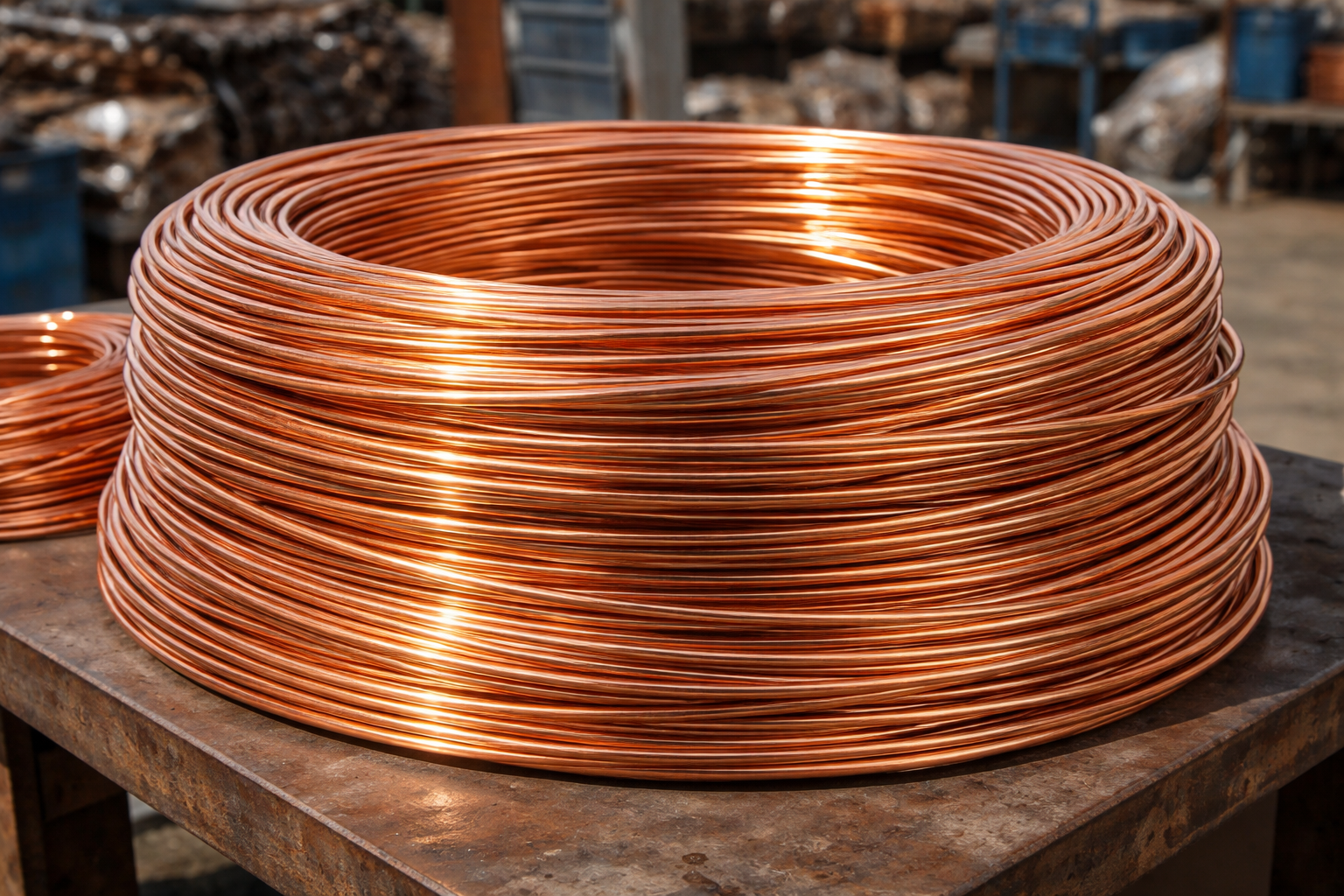

Non ferrous metals are metals and alloys that do not contain iron as a major component, which is why they resist rust and never lose their strength to magnetic tools. If you have ever wondered why a copper pipe never rusts the way an old iron nail does, the answer lies in this simple but important classification. Non ferrous metals are one of the two major types of metals, prized for their resistance to corrosion, light weight, and strong electrical and thermal conductivity, making them essential in everything from home wiring to aircraft parts. This guide breaks down what non ferrous metals actually are, how they differ from ferrous metals, the most common examples you interact with every day, their properties, uses across major industries, and why recycling them matters both environmentally and economically. Whether you are a student, a metal buyer, or simply curious, this article gives you a clear and complete picture of non ferrous metals.
The non ferrous metals definition centers on one simple fact: these are metals and alloys that either contain no iron at all or contain only a trace amount that is too small to affect their core behavior. This single distinction explains almost everything about how non ferrous metals act, from the way they resist rust to the way they respond to a magnet. Common examples include copper, aluminium, zinc, tin, lead, and nickel, along with precious metals such as gold, silver, and platinum. Even alloys like brass and bronze fall under this category because their base composition avoids significant iron content.
Understanding what non ferrous metals mean also requires understanding what they are not. Ferrous metals, by contrast, use iron as their primary building block, which gives them strength but also makes them prone to rust and magnetic attraction. Since non ferrous metals skip iron almost entirely, oxygen and moisture cannot trigger the same reaction, so these metals do not rust in the traditional sense. Some non ferrous metals can still corrode over time through other chemical reactions, but this is a slower and different process than the red flaking rust seen on iron and steel.
This absence of iron is also why non ferrous metals are non magnetic in almost every case, which makes them valuable in electronics, medical equipment, and any setting where magnetic interference needs to be avoided.
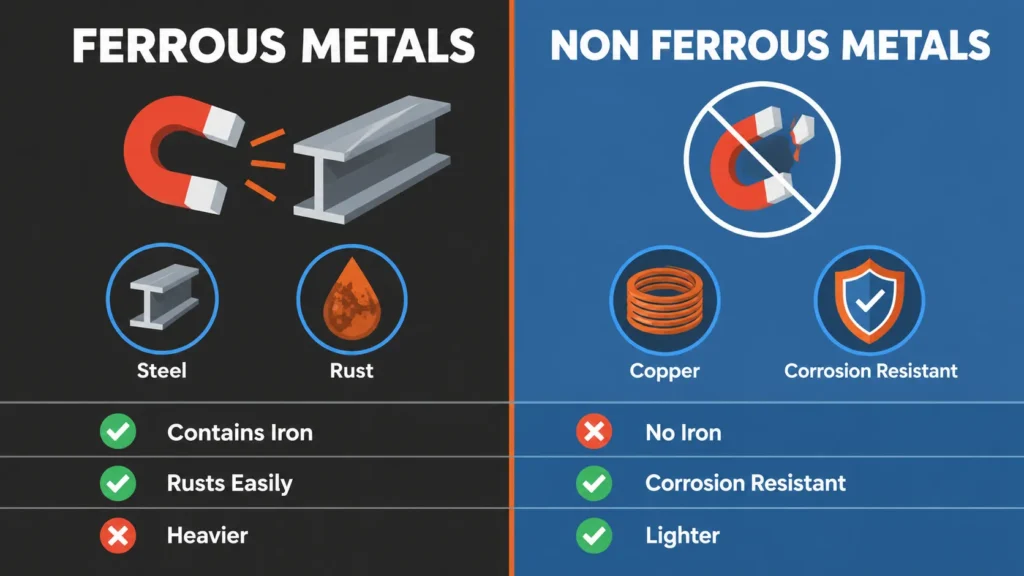
When people search for ferrous vs non ferrous metals, they are usually trying to understand which type of metal fits their specific need, whether that is building a structure, wiring a house, or choosing material for an outdoor fixture. The core difference comes down to iron content. Ferrous metals contain iron as a major element, which gives them excellent tensile strength and makes them a common choice for heavy construction, machinery, and structural beams. Non ferrous metals skip that iron content, trading some raw strength for corrosion resistance, lighter weight, and better conductivity.
This tradeoff matters in real world decisions. A steel beam holds up a building because of its strength, but a copper wire carries electricity efficiently because it is non ferrous and highly conductive. Neither type is universally better; the right choice depends entirely on the application.
Property | Ferrous Metals | Non Ferrous Metals |
Iron content | High | None or trace amount |
Magnetic | Usually yes | Usually no |
Corrosion resistance | Low, prone to rust | High |
Weight | Generally heavier | Generally lighter |
Common examples | Steel, cast iron | Copper, aluminium, zinc, brass |
Typical use case | Structural, heavy machinery | Electrical, aerospace, plumbing |
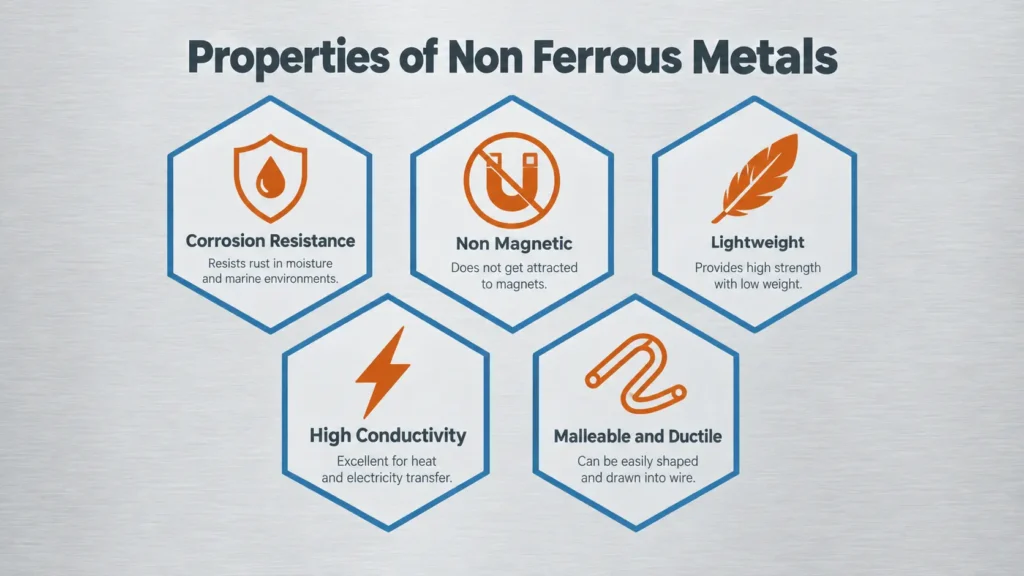
Non ferrous metals share several core properties that explain why industries reach for them again and again, even though they often cost more than steel or cast iron. These non ferrous metals properties are not just academic facts; they are the reason a specific metal ends up in a specific product.
Because non ferrous metals contain little to no iron, they do not rust the way ferrous metals do. Many of them, such as aluminium and copper, form a thin protective oxide layer on their surface almost immediately after exposure to air. This layer acts as a natural shield, slowing down or completely stopping further corrosion underneath it.
This is why non ferrous metals are the default choice for plumbing, roofing, marine hardware, and any application exposed to constant moisture. A copper pipe buried underground for decades can still function properly, while an unprotected iron pipe in the same conditions would eventually rust through.
One of the easiest ways to tell non ferrous metals apart from ferrous metals is by their magnetic behavior, or rather the lack of it. Since magnetism in metals is closely tied to iron content, and non ferrous metals contain little to none, a simple magnet test can instantly separate the two categories in a scrapyard or workshop.
This non magnetic quality is not just a fun fact; it has real industrial value. MRI machines, aerospace instruments, and sensitive electronics all rely on non ferrous metals specifically because they will not interfere with magnetic fields or get pulled toward magnetic components.
Many non ferrous metals, especially aluminium and titanium, offer a strength to weight ratio that ferrous metals simply cannot match. A piece of aluminium can weigh roughly a third of what the same sized piece of steel weighs, while still holding up under real structural loads when properly alloyed.
This property has reshaped entire industries. Aircraft, high speed trains, and modern vehicles increasingly favor non ferrous metals in their frames and body panels because every kilogram saved translates directly into better fuel efficiency and performance.
Copper and aluminium in particular are exceptional conductors of both electricity and heat, which is why they dominate the wiring and heat exchange industries. Copper offers slightly better conductivity, but aluminium is lighter and cheaper, so engineers choose between the two based on the specific tradeoff their project demands.
This conductivity also extends to everyday cookware and industrial heat exchangers, where non ferrous metals move heat quickly and evenly, improving efficiency and reducing energy waste.
Most non ferrous metals can be hammered into thin sheets or drawn into fine wires without cracking, a property known as malleability and ductility. Gold and silver are the most extreme examples, capable of being shaped into incredibly thin foils, while copper and aluminium strike a practical balance between workability and strength.
This flexibility during manufacturing allows non ferrous metals to be formed into complex shapes through rolling, extrusion, and drawing, which is essential for everything from jewelry making to precision engineering components.
Non ferrous metals can typically be recycled indefinitely without losing their core properties, unlike some ferrous metals that degrade slightly with each recycling cycle. This makes recycling both an environmental win and an economic one, since remelting scrap non ferrous metal uses far less energy than extracting and refining new metal from ore.
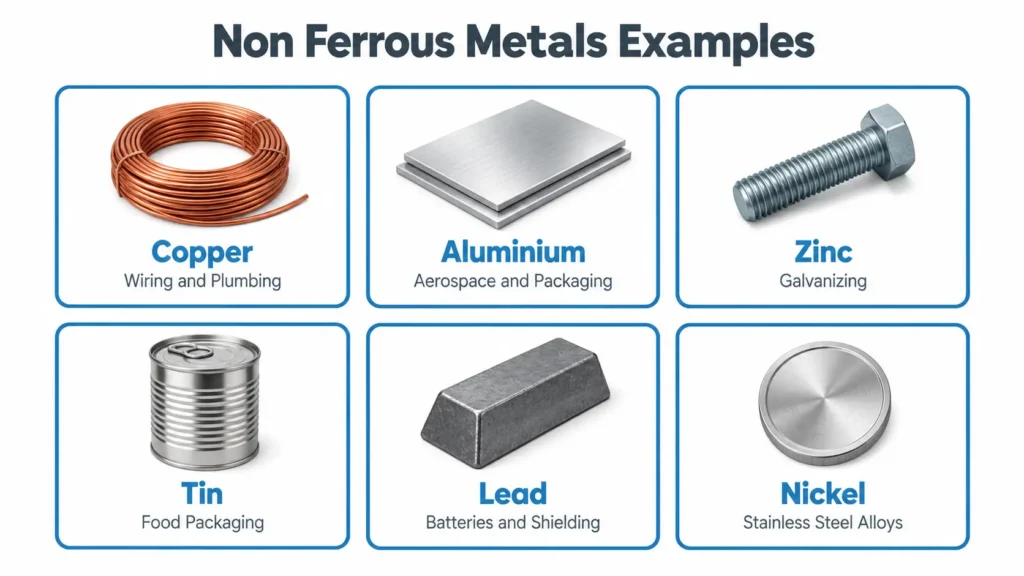
Understanding non ferrous metals examples in detail makes the earlier properties feel less abstract and more practical. Each of these metals earns its place in industry because of a specific combination of traits, not just general non ferrous characteristics.
Copper is often the first metal people think of when discussing non ferrous metals examples, and for good reason. It offers outstanding electrical and thermal conductivity, second only to silver among common metals, while remaining far more affordable and abundant. This combination makes copper the backbone of electrical wiring, power transmission lines, and countless electronic components found in homes and industries worldwide.
Beyond conductivity, copper is highly ductile and resistant to corrosion, which explains its long history in plumbing systems and roofing. Over time, exposed copper develops a distinctive green patina, a natural oxide layer that actually protects the metal underneath rather than weakening it. This same durability is why copper is also a favorite material for statues, architectural accents, and cookware, where both function and appearance matter.
Aluminium stands out among non ferrous metals for its remarkably low density combined with a naturally forming protective oxide layer. As soon as aluminium is exposed to air, this thin oxide coating forms almost instantly and prevents further corrosion, which is why aluminium products rarely show visible rust or decay even after years of outdoor use.
Its strength to weight ratio has made aluminium indispensable in aerospace, automotive manufacturing, and packaging. Aircraft bodies, car frames, and even soda cans rely on aluminium because it dramatically reduces weight without sacrificing enough strength to matter for the application. Aluminium is also one of the most recycled metals globally, since remelting it uses only a small fraction of the energy required to produce new aluminium from raw bauxite ore.
Zinc rarely gets attention on its own, but it plays a critical protective role as a coating metal through a process called galvanization. When steel or iron is coated with a layer of zinc, that zinc layer corrodes first and sacrifices itself to protect the metal underneath, dramatically extending the lifespan of the base material.
Beyond galvanization, zinc is a key ingredient in alloys like brass, where it combines with copper to create a stronger and more workable metal. Zinc also shows up in die casting for small precision parts, in batteries, and in certain paints where its oxide form provides a bright white pigment. Its relatively low melting point makes it easy and energy efficient to work with compared to many other metals.
Tin has a long industrial history, largely thanks to its low toxicity and low melting point, both of which make it an ideal coating material for food packaging. Tin plated steel, commonly used in cans for food and beverages, relies on a thin tin layer to prevent the steel underneath from reacting with the contents and causing spoilage or contamination.
Tin also plays a major role in soldering, where its low melting point allows it to join electronic components and plumbing fixtures without damaging the surrounding materials. When alloyed with copper, tin produces bronze, one of the oldest and most historically significant alloys in human history, still valued today for sculptures, marine hardware, and specialized bearings.
Lead is one of the densest common non ferrous metals, a property that has kept it relevant in applications like radiation shielding and car batteries despite growing environmental restrictions. Its resistance to corrosion and chemical reactions means lead components can last for decades in demanding conditions, particularly in acid based environments like lead acid batteries.
However, lead’s toxicity has significantly reduced its use in consumer products over the past several decades, with lead paint, leaded gasoline, and lead pipes now banned or heavily restricted in most developed countries. Modern use of lead is largely confined to industrial and specialized applications where its unique density and malleability genuinely cannot be replaced, always handled with strict safety protocols.
Nickel is prized for its toughness and its ability to perform reliably across extreme temperature ranges, from cryogenic cold to high heat aerospace environments. On its own, nickel is rarely used in pure form; instead, it is most valuable as an alloying element that boosts the corrosion resistance and strength of other metals.
Its most well known role is in stainless steel, where nickel combined with chromium creates a material that resists both rust and staining far better than plain steel alone. Nickel based alloys also appear in jet engine components, marine hardware, and battery technology, particularly in lithium ion batteries where nickel improves energy density and performance.
Having a clear ferrous and non ferrous metals list side by side makes it much easier to quickly identify which category a specific metal falls into, especially for buyers, students, or anyone sorting scrap metal. While the properties discussed earlier explain the reasoning behind each category, sometimes a simple reference list is exactly what someone needs.
Ferrous metals generally include steel, cast iron, wrought iron, and various carbon and alloy steels used in construction and heavy machinery. Almost all of these contain a significant percentage of iron, which is why they respond to magnets and require protective coatings or treatments to prevent rust in humid or wet environments.
Non ferrous metals, on the other hand, cover a much broader and more diverse group. This includes common industrial metals like copper, aluminium, zinc, tin, lead, and nickel, along with precious metals such as gold, silver, and platinum. Alloys like brass and bronze also belong here, since their base metals avoid meaningful iron content even though they are technically blends rather than pure elements.
Ferrous Metals | Non Ferrous Metals |
Steel, Cast Iron, Wrought Iron, Carbon Steel, Alloy Steel | Copper, Aluminium, Zinc, Tin, Lead, Nickel, Brass, Bronze, Gold, Silver, Platinum |
A quick way to remember the split: if a metal rusts and sticks to a magnet, it almost certainly belongs on the ferrous side of this list; if it resists rust and ignores a magnet, it belongs on the non ferrous side.
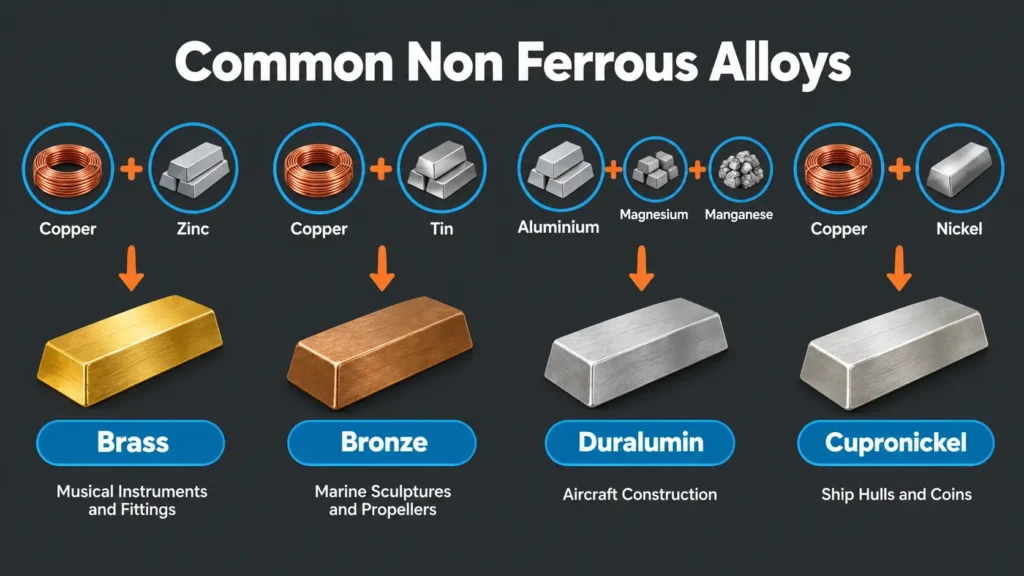
Non ferrous metals and alloys go hand in hand, since many of the most useful non ferrous materials in everyday life are not pure metals at all but carefully engineered combinations. Alloying allows manufacturers to combine the best traits of two or more metals while minimizing their individual weaknesses.
Brass is an alloy of copper and zinc, and it consistently ranks among the most recognizable non ferrous metal products people encounter daily, from doorknobs and musical instruments to plumbing fittings. The exact ratio of copper to zinc can be adjusted to shift brass toward more strength or more workability, which is why different brass grades exist for different purposes.
Musicians favor brass instruments partly because of its acoustic qualities, while plumbers and locksmiths rely on it for its corrosion resistance and relatively low friction when moving parts rub against each other. Brass also resists a wear pattern called galling, where metal surfaces seize and tear against one another, making it ideal for gears, valves, and hinges that see constant use.
Bronze, an alloy primarily of copper and tin, holds a unique place in human history as the material that gave the Bronze Age its name. Ancient civilizations relied on bronze for tools and weapons long before iron smelting became widespread, and the metal remains valued today for very practical modern reasons.
Bronze offers excellent corrosion resistance, particularly in marine environments where saltwater would quickly damage many other metals. This is why bronze remains a common choice for boat propellers, marine fittings, and outdoor sculptures that need to withstand decades of weather exposure without significant degradation.
Beyond brass and bronze, several other non ferrous alloys serve specialized purposes across different industries. Duralumin, an aluminium alloy strengthened with copper, magnesium, and manganese, offers a strength boost over pure aluminium while keeping weight low, making it a historically important material in aircraft construction.
Cupronickel, a blend of copper and nickel, resists corrosion exceptionally well in seawater, which explains its widespread use in ship hulls, coins, and marine piping systems. Each of these alloys demonstrates the same underlying principle: combining non ferrous metals in the right proportions can produce materials that outperform any single metal on its own.
Some metals cause genuine confusion when people try to sort them into ferrous or non ferrous categories, either because of their name, their appearance, or the way they are marketed. Clearing up these special cases helps avoid costly mistakes, especially when selling scrap or choosing materials for a specific project.
One of the most common questions people ask is whether stainless steel is a non ferrous metal, and the answer is no. Despite its shiny, corrosion resistant appearance that often makes people assume it behaves like a non ferrous metal, stainless steel is fundamentally an iron based alloy, typically combining iron with chromium and sometimes nickel. Its resistance to rust comes from the chromium content forming a protective oxide layer, not from an absence of iron, which means stainless steel is classified as ferrous even though it does not behave like typical rust prone steel.
Is brass a non ferrous metal? The answer is a straightforward yes. Brass is made from copper and zinc, two metals that both fall firmly under the non ferrous category, so any alloy built from them inherits that same classification regardless of the exact ratio used.
Is gold a non ferrous metal? The answer is equally clear: yes, since gold is a pure element that contains no iron whatsoever. Along with silver and platinum, gold belongs to a special subset of non ferrous metals known as precious metals, valued not just for industrial use but for their rarity, appearance, and resistance to virtually all forms of corrosion. You can read more about gold and its properties in our dedicated guide.
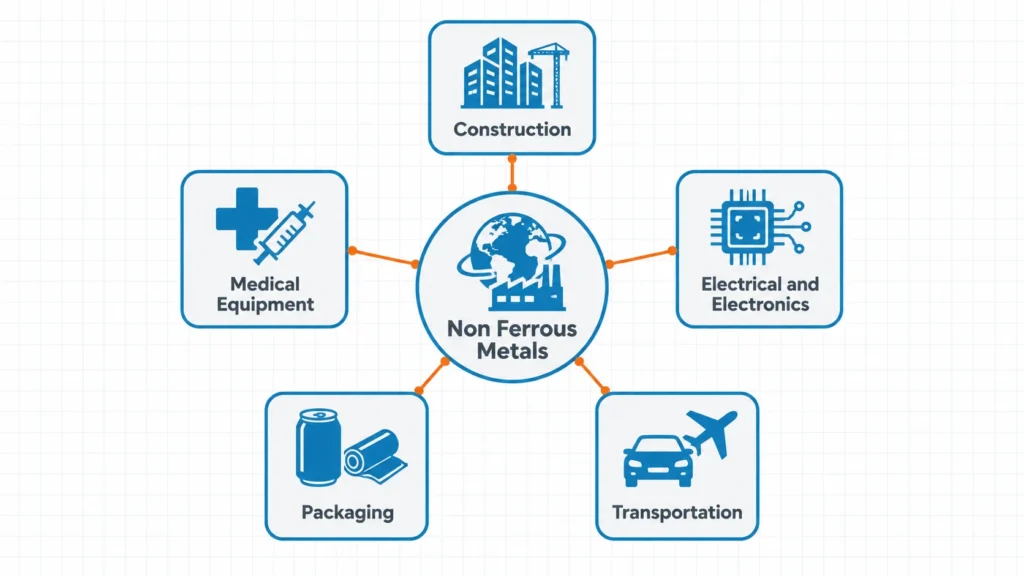
The real value of non ferrous metals becomes obvious once you look at how many industries depend on them for functions that ferrous metals simply cannot handle as effectively. From the moment someone wakes up and flips a light switch to the flight they might take later that day, non ferrous metals are working quietly in the background.
Non ferrous metals appear throughout modern construction in roofing, cladding, piping, and decorative architectural elements. Copper roofing can last well over a century with minimal maintenance, while aluminium framing and window fixtures resist the corrosion that would quickly damage untreated steel in the same outdoor conditions.
This is arguably where the impact of non ferrous metals on industry is most visible day to day. Copper wiring runs through nearly every building, carrying electricity safely and efficiently, while aluminium handles long distance power transmission where its lighter weight reduces the load on transmission towers. Circuit boards, connectors, and countless electronic components also depend on non ferrous metals for their conductivity and non magnetic properties.
In transportation, weight reduction is where non ferrous metals genuinely shine. Aluminium and titanium alloys cut the overall weight of vehicles and aircraft, directly improving fuel efficiency without compromising structural safety when properly engineered. Copper wiring throughout these vehicles also handles the increasingly complex electrical systems found in modern transportation.
Aluminium and tin dominate the packaging world, appearing in beverage cans, foil, and food containers where their lightweight nature, hygiene, and recyclability all matter. Tin plated steel cans keep food safe for years on a shelf, while aluminium foil provides an airtight barrier that protects everything from leftovers to pharmaceutical products.
Non ferrous metals like platinum, titanium, and aluminium show up frequently in medical settings because of their biocompatibility, corrosion resistance, and non magnetic properties. Surgical instruments, medical implants, and equipment used near MRI machines all rely on non ferrous metals specifically because they will not interfere with magnetic fields or react poorly inside the human body.
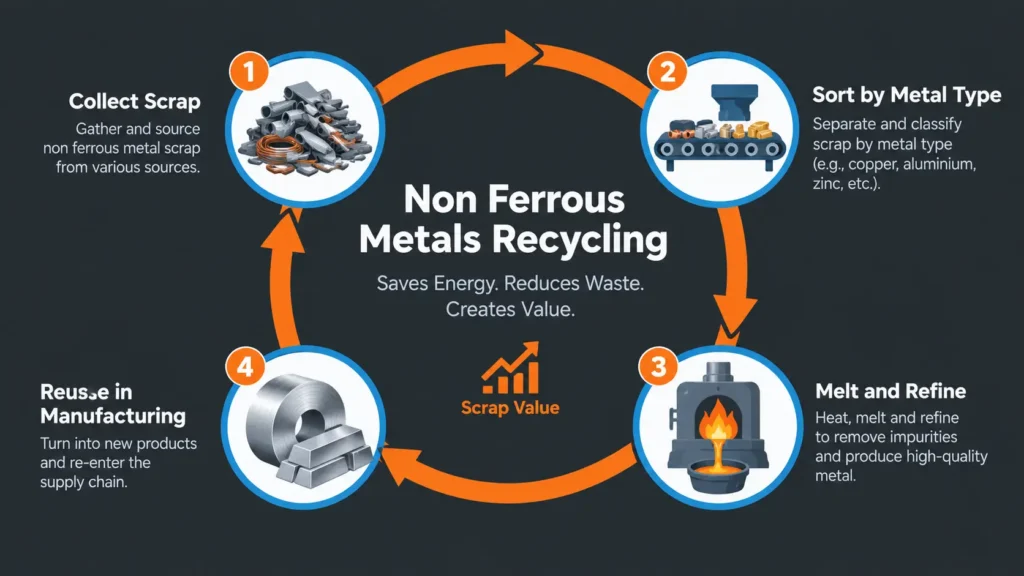
Non ferrous metals recycling stands out as one of the most efficient and economically rewarding forms of metal recycling available today. Unlike some materials that degrade in quality with each recycling cycle, most non ferrous metals can be melted down and reused repeatedly without losing their core properties or performance.
The environmental case for recycling is straightforward. Producing new aluminium from raw bauxite ore requires significantly more energy than simply remelting existing aluminium scrap, and the same general principle holds true for copper, zinc, and other common non ferrous metals. This energy savings translates directly into lower greenhouse gas emissions and reduced strain on natural mineral resources that would otherwise need to be mined.
There is also a strong financial incentive built into non ferrous metals scrap. Because these metals hold real value even after their original use has ended, scrapyards and recycling centers actively pay for materials like copper, aluminium, and brass, creating a genuine market around collecting and processing them. In the United States, industry bodies such as the Institute of Scrap Recycling Industries track this scrap economy closely, since non ferrous metals scrap prices fluctuate based on global commodity benchmarks like the London Metal Exchange, current demand from manufacturing sectors, and the purity of the scrap being sold. Clean, well sorted copper grades, such as bare bright copper wire, typically command the highest non ferrous metals prices among common scrap metals, and current rates can be tracked on our metal prices page.
This recycling economy also supports local jobs in collection, sorting, and processing, while reducing the volume of metal waste that would otherwise end up in landfills. For anyone holding onto old wiring, aluminium cans, or discarded brass fittings, recycling represents both a responsible environmental choice and a practical way to recover some value from materials that would otherwise go to waste.
Beyond their industrial uses, there are plenty of interesting non ferrous metals facts that reveal just how deeply these materials are woven into human history and daily life in ways many people never stop to consider.
Copper was among the very first metals humans ever worked with, predating iron use by thousands of years, and archaeologists have found copper tools and ornaments dating back over 10,000 years. Gold remains the most malleable of all metals, meaning a single ounce can theoretically be hammered into a sheet thin enough to cover several hundred square feet without tearing. Aluminium, despite being the most abundant metal in the earth’s crust, was once considered more precious than gold because early extraction methods were extremely difficult and expensive before modern electrolysis processes made large scale production possible.
Nearly eighty percent of all the copper ever mined throughout human history is still in circulation today, either in active use or sitting in recycling streams waiting to be reprocessed, a testament to how durable and reusable non ferrous metals truly are. Silver holds the record for the highest electrical and thermal conductivity of any metal, which is why it appears in high performance electronics and specialized applications despite its higher cost compared to copper.
Non ferrous metals are metals and alloys that contain little to no iron in their composition. This absence of iron means they resist rust, remain non magnetic, and often offer better corrosion resistance and conductivity than ferrous metals. Common examples include copper, aluminium, zinc, tin, lead, nickel, and precious metals like gold and silver.
Ferrous metals include steel, cast iron, wrought iron, and various carbon and alloy steels. These metals contain iron as a primary component, which gives them strength and magnetic properties but also makes them prone to rust when exposed to moisture without protective coatings or treatments.
The most widely used non ferrous metals include copper, aluminium, zinc, tin, lead, and nickel, along with precious metals like gold, silver, and platinum. Each offers a unique combination of conductivity, corrosion resistance, weight, and workability, which is why industries choose specific ones based on their particular application needs.
A basic non ferrous metals list includes copper, aluminium, zinc, tin, lead, and nickel as common industrial metals, alongside gold, silver, and platinum as precious metals. Alloys such as brass and bronze also belong on this list since their base metals avoid meaningful iron content.
Ferrous metals on this list include steel, cast iron, and wrought iron, all containing significant iron content. Non ferrous metals include copper, aluminium, zinc, tin, lead, nickel, brass, bronze, gold, silver, and platinum, none of which contain enough iron to be magnetic or prone to rusting.
Yes, gold is a non ferrous metal. As a pure element containing no iron whatsoever, gold falls under the precious metals subcategory of non ferrous metals, valued for its rarity, corrosion resistance, and extreme malleability rather than structural strength.
No, stainless steel is a ferrous metal. Although it resists rust and looks similar to some non ferrous metals, stainless steel is fundamentally an iron based alloy combined with chromium and sometimes nickel, and its corrosion resistance comes from chromium rather than an absence of iron.
Yes, brass is a non ferrous metal. It is an alloy made from copper and zinc, both of which are non ferrous metals themselves, so brass naturally inherits that same classification regardless of the specific ratio of copper to zinc used.
Non ferrous metals are used across construction, electrical wiring, transportation, packaging, and medical equipment. Their corrosion resistance, light weight, and strong conductivity make them essential for products ranging from copper wiring and aluminium aircraft parts to tin plated food cans.
The core difference is iron content. Ferrous metals contain significant iron, making them strong but prone to rust and magnetic. Non ferrous metals contain little to no iron, making them more corrosion resistant, generally lighter, and non magnetic, though often at a higher cost.
Non ferrous metals play a far bigger role in daily life than most people realize, quietly powering everything from home electrical systems to aircraft frames and food packaging. Understanding what separates them from ferrous metals, whether through their resistance to rust, their non magnetic nature, or their impressive conductivity, makes it much easier to choose the right material for any project, purchase, or recycling decision. As industries continue prioritizing lighter, more sustainable materials heading into 2026 and beyond, demand for non ferrous metals like copper, aluminium, and their alloys is only expected to grow. Whether you are recycling old wiring, selecting materials for a build, or simply satisfying your curiosity, this guide gives you a solid, practical foundation for understanding non ferrous metals and where they fit into the world around you.

MetalsWiki.com offers accurate, up-to-date information on metals and real-time scrap metal prices for traders, recyclers, and professionals.