
Platinum is one of the rarest and most valuable metals on Earth rarer than gold, denser than silver, and tough enough to survive centuries without losing its shine. Yet most people only know it as a jewelry term, without realizing platinum quietly powers everything from car exhaust systems to cancer treatment drugs.
This guide covers everything about platinum metal: what it is, its physical and chemical properties, how it compares to gold and silver, where it’s mined, what drives its price, and its growing demand in Pakistan’s jewelry and investment market.
Platinum is a chemical element with the symbol Pt and atomic number 78. It belongs to a group of six related elements – platinum, palladium, rhodium, iridium, osmium, and ruthenium – collectively called the platinum group metals (PGMs).
The name “platinum” comes from the Spanish word platina, meaning “little silver,” a name early Spanish explorers gave it in South America because they initially considered it an inferior, unworkable version of silver. Ironically, platinum turned out to be significantly rarer and more valuable.
Platinum was formally identified by Antonio de Ulloa in 1735, though pre-Columbian civilizations in South America were already using it centuries earlier. Industrial use of platinum only picked up in the 19th century, once metallurgists developed the techniques needed to melt and shape a metal with such an extremely high melting point.
Platinum’s properties are what make it valuable across such different industries from a wedding ring to a spacecraft component. Few metals combine rarity, strength, and chemical stability the way platinum does, and that rare mix is exactly why engineers, jewelers, and doctors all rely on it for very different reasons.
On one end, platinum’s dense, lustrous, corrosion-proof surface makes it a natural choice for fine jewelry that has to survive decades of daily wear without losing its shine. On the other end, its extremely high melting point and resistance to chemical attack make it indispensable in environments most metals simply can’t survive inside a car’s exhaust system, a jet engine, or a piece of medical equipment sterilized thousands of times over.
What sets platinum apart from most other metals is that it rarely has to compromise. Gold is soft and needs alloying to gain strength. Silver tarnishes over time. Many industrial metals corrode or lose strength at high temperatures. Platinum, by contrast, holds its shape, resists oxidation, and stays chemically stable even under extreme heat and repeated exposure to acids which is exactly why it shows up in such a wide, and seemingly unrelated, range of industries.
Here’s a full breakdown of platinum’s physical, chemical, mechanical, and thermal properties.
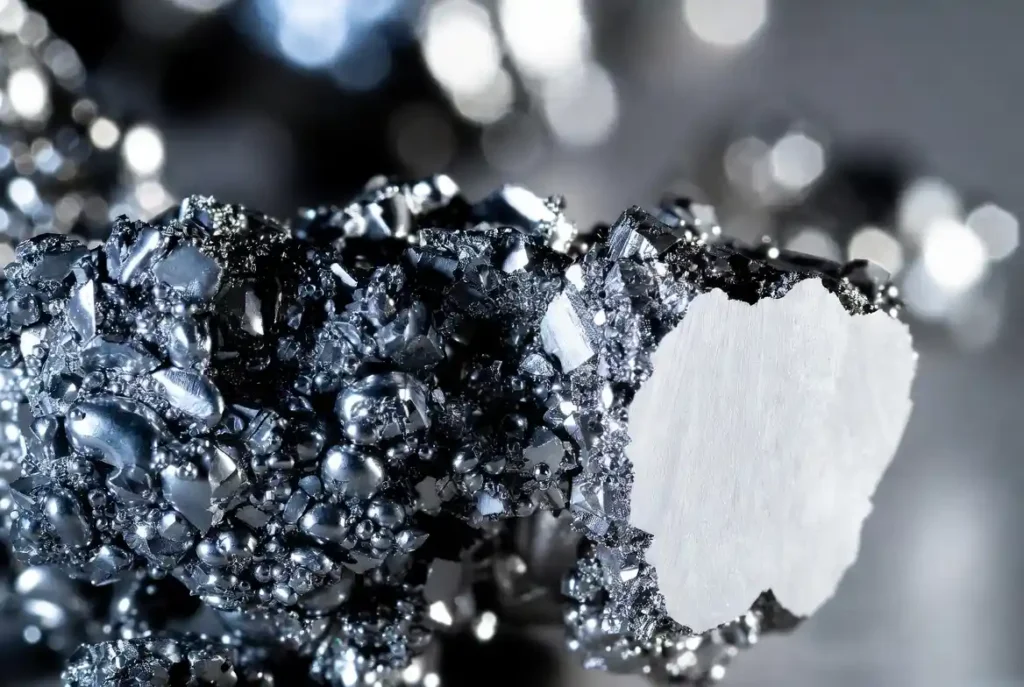
Platinum is a dense, silvery white metal with a naturally lustrous finish. In its pure form, it’s soft enough to be shaped but heavy enough to feel substantial a big part of why it’s prized in fine jewelry.
Platinum’s chemical stability is the reason it’s trusted in medical implants and industrial equipment that has to survive harsh environments for decades.
Property | Value |
Symbol | Pt |
Atomic Number | 78 |
Atomic Weight | 195.08 g/mol |
Density | 21.45 g/cm³ |
Melting Point | 1,768°C (3,215°F) |
Boiling Point | 3,825°C (6,917°F) |
Thermal Conductivity | 69.1 W/m·K |
Electrical Conductivity | ~9.43 × 10⁶ S/m |
Hardness (Vickers) | 400–550 MPa |
Electronic Configuration | [Xe] 4f14 5d9 6s1 |
Group (Periodic Table) | 10 |
These figures explain why platinum shows up in such demanding applications – high heat tolerance for jet engines, strong conductivity for electronics, and enough hardness to hold gemstones securely for a lifetime.
This is the comparison most people actually search for – and the numbers often surprise people.
Platinum is generally priced lower than gold today, which confuses a lot of buyers who assume “rarer automatically means more expensive.” Here’s the real picture:
Silver is far more abundant and significantly cheaper than platinum. While silver is a good conductor and used heavily in electronics and photography, it tarnishes over time and isn’t nearly as corrosion-resistant as platinum. Platinum’s rarity and stability keep it firmly in the “precious metal” investment category, while silver is treated more as an industrial-plus-investment hybrid metal.
Palladium is platinum’s closest relative – both are platinum group metals used heavily in catalytic converters. Palladium is generally lighter and has, at various points, traded at a higher price than platinum due to tighter supply in specific years. For jewelry, though, platinum remains the more popular and more durable choice.

Platinum’s combination of rarity, strength, and chemical stability makes it useful across a surprisingly wide range of industries.
Getting platinum out of the ground and into a finished bar is one of the most demanding processes in the entire metals industry far more involved than mining gold or silver. Platinum doesn’t occur in large, easily separable deposits. It’s scattered in tiny concentrations within specific ore bodies, almost always alongside other platinum group metals, which means every stage of extraction has to be precise to avoid losing the small amounts of metal actually present.
This difficulty is a big part of why platinum carries the value it does. From locating a viable ore deposit to producing a 99.9% pure bar, the journey can take months and involves a long chain of mechanical, chemical, and electrolytic processes. Here’s how it works, from the mine to the finished metal.
Platinum mining is heavily concentrated in a handful of countries. South Africa alone accounts for around 70–75% of global platinum supply, making it by far the world’s largest producer. Russia, Zimbabwe, Canada, and the United States round out the rest of the world’s major sources. Some platinum is also recovered as a by-product of copper and nickel mining.
Platinum is extremely scarce in the Earth’s crust mining companies typically need to process 10 to 40 tons of ore just to produce a single ounce of refined platinum.
This entire process can take up to six months from ore to refined metal, which is part of why platinum commands a premium despite fluctuating market prices.
Platinum is rarely mined alone. It occurs naturally alongside five closely related elements palladium, rhodium, iridium, osmium, and ruthenium collectively known as the platinum group metals. These metals share similar chemical properties and are typically separated from each other during the refining process, with each finding its own specialized industrial use.
Unlike gold, whose price is largely driven by investment demand, platinum’s value is shaped more heavily by industrial consumption. Key factors include:
For real-time platinum and other precious metal rates, check our regularly updated Scrap & Precious Metal Prices page.
Platinum jewelry is still a smaller market in Pakistan compared to gold, but demand has been steadily growing especially among buyers looking for a modern alternative to traditional gold sets, and among men’s jewelry buyers (platinum rings and chains have grown in popularity).
A few things to know if you’re buying or pricing platinum in Pakistan:
Is platinum rarer than gold? Yes. Roughly 190 tons of platinum are mined globally each year, compared to about 3,300 tons of gold making platinum significantly rarer by production volume.
What is platinum used for? Platinum’s main uses include jewelry, automotive catalytic converters, medical devices (pacemakers, chemotherapy drugs), electronics, laboratory equipment, and aerospace components.
Is platinum cheaper or more expensive than gold? It depends on market conditions. Platinum is often priced lower than gold today because its value is more tied to industrial and automotive demand, while gold’s price is driven more by investment and reserve demand. Historically, platinum has traded both above and below gold’s price.
How is platinum mined? Platinum is mined through underground drilling and blasting, followed by crushing, froth flotation, smelting, and electrolytic refining to reach 99.9% purity.
What is the atomic number of platinum? Platinum’s atomic number is 78, with the chemical symbol Pt.
Is platinum a good investment? Platinum can be part of a diversified precious metals portfolio, but its price tends to be more volatile than gold due to its dependence on industrial demand, particularly from the automotive sector. As with any investment, it’s worth researching current market conditions and consulting a financial advisor before investing.
Platinum earns its place as one of the world’s most valuable metals through a rare combination of scarcity, strength, and chemical stability. Whether you’re comparing it to gold for a jewelry purchase or trying to understand what drives its market price, the key takeaway is that platinum’s value comes from real industrial demand not just prestige.
For more on precious metals, explore our guides on Gold, Silver, and Palladium.

MetalsWiki.com offers accurate, up-to-date information on metals and real-time scrap metal prices for traders, recyclers, and professionals.