
Not sure which metal fits your project, or which one is even magnetic? You are not alone. With dozens of metals used across construction, electronics, and jewelry, picking the right one can feel confusing fast.
There are several types of metals, and each one is grouped by its properties, composition, and how it behaves under heat, pressure, or moisture. The main categories are ferrous, non ferrous, precious metals, and alloys, with metals further classified on the periodic table by their atomic structure.
This guide breaks down every major type of metal, explains what makes each one unique, and shows exactly where each one is used in everyday life. You will also find a quick reference chart, a properties breakdown, and answers to the most common questions people search for. Where a metal or category deserves a deeper dive, this guide links out to a full dedicated breakdown.
By the end, you will know exactly how metals are classified, what separates a metal from a non metal, and which broad category fits your specific need, whether that is a construction project, a piece of jewelry, or simple curiosity.
Metals are elements that conduct heat and electricity, hold a shiny surface called luster, and can be shaped without breaking. According to the Royal Society of Chemistry, 94 of the elements on the periodic table are classified as metals, making them the largest single group of elements in chemistry. This single fact explains why metal touches almost every industry on earth, from the coins in your pocket to the frame of the building you are sitting in right now. Understanding what actually qualifies something as a metal is the foundation for everything else covered in this guide.
What sets metals apart from non metals and from materials like plastic or ceramic comes down to a small set of shared physical traits, and each one has a direct real world consequence. A metal that is malleable can become a car body panel. A metal that is a poor conductor would be useless for wiring. Below are the core traits that define a metal, along with why each one matters in practice:
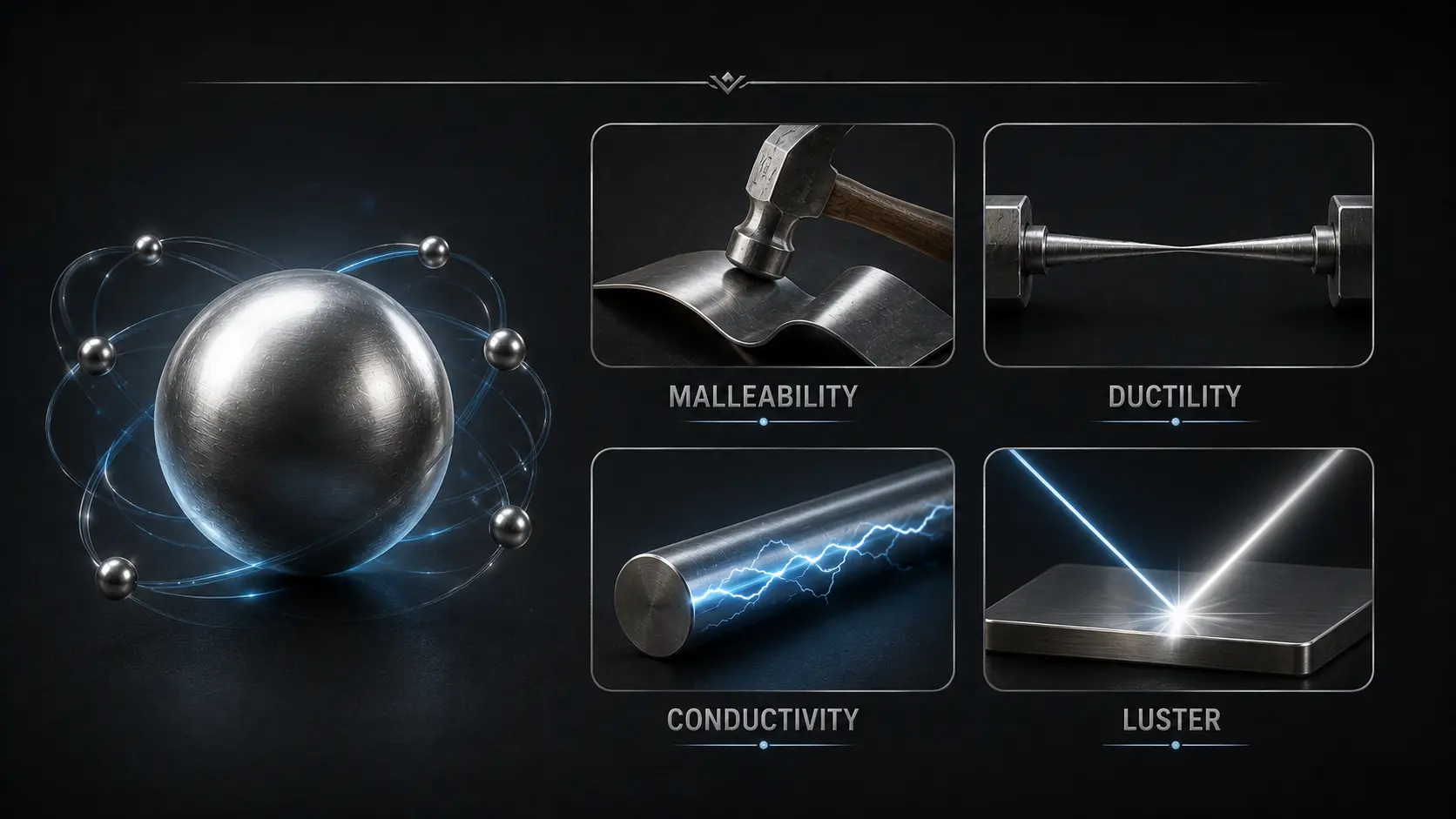
These properties are not random. They come directly from how metal atoms are structured at the atomic level. Metal atoms tend to lose their outer electrons easily, and those free electrons move through the material almost like a shared cloud, which is exactly why metals conduct electricity and heat so efficiently compared to non metals. This same electron behavior is also responsible for the metallic bond that gives metals their strength and flexibility at the same time, a combination rarely found in other material types.
Not every metal behaves identically, though, and this is where classification becomes useful. Iron rusts within days if left outdoors, while gold can sit underground for centuries and still shine when recovered. Aluminum is light enough that it is a preferred choice wherever weight matters, while tungsten is so dense it feels like holding a stone twice its size. Because of these real differences in weight, reactivity, and strength, metals are sorted into practical categories such as ferrous, non ferrous, precious, and alloys, each covered in detail later in this guide.
Before diving deeper into metal categories, it helps to understand what separates a metal from a non metal in the first place, since this distinction shapes everything from industrial material selection to basic chemistry education. The easiest way to tell a metal from a non metal is a simple touch and observation test: metals feel cold to the touch because they conduct heat away from your hand quickly, they look shiny under light, and they conduct electricity when tested with a simple circuit. Non metals usually fail all three of these tests, feeling closer to room temperature, appearing dull, and blocking rather than conducting electrical current.
This difference is not arbitrary; it comes directly from where each element sits on the periodic table. Metals occupy the left and center portion of the table, non metals sit in the upper right corner, and a thin diagonal line of elements called metalloids runs between the two, sharing properties from both sides. This positioning reflects how many electrons each element’s atoms tend to gain or lose, which in turn determines whether that element behaves like a metal or not.
Here is a side by side comparison covering the practical differences that matter most:
Property | Metals | Non Metals |
Appearance | Shiny (lustrous) | Dull |
State at room temp | Mostly solid (except mercury) | Solid, liquid, or gas |
Conductivity | Good conductors | Poor conductors (insulators) |
Malleability | Malleable and ductile | Brittle if solid |
Density | Generally high | Generally low |
Examples | Iron, copper, gold, aluminum | Oxygen, sulfur, carbon, nitrogen |
Metalloids like silicon, boron, and germanium occupy a genuinely unique middle ground, and they deserve a closer look because of how important they have become in modern technology. These elements conduct electricity, but only under certain conditions such as added heat, light, or impurities, a property called semiconduction. This exact behavior is why silicon has become the foundation of computer chips, solar panels, and nearly every modern electronic device, since engineers can precisely control when a silicon based component conducts and when it does not.
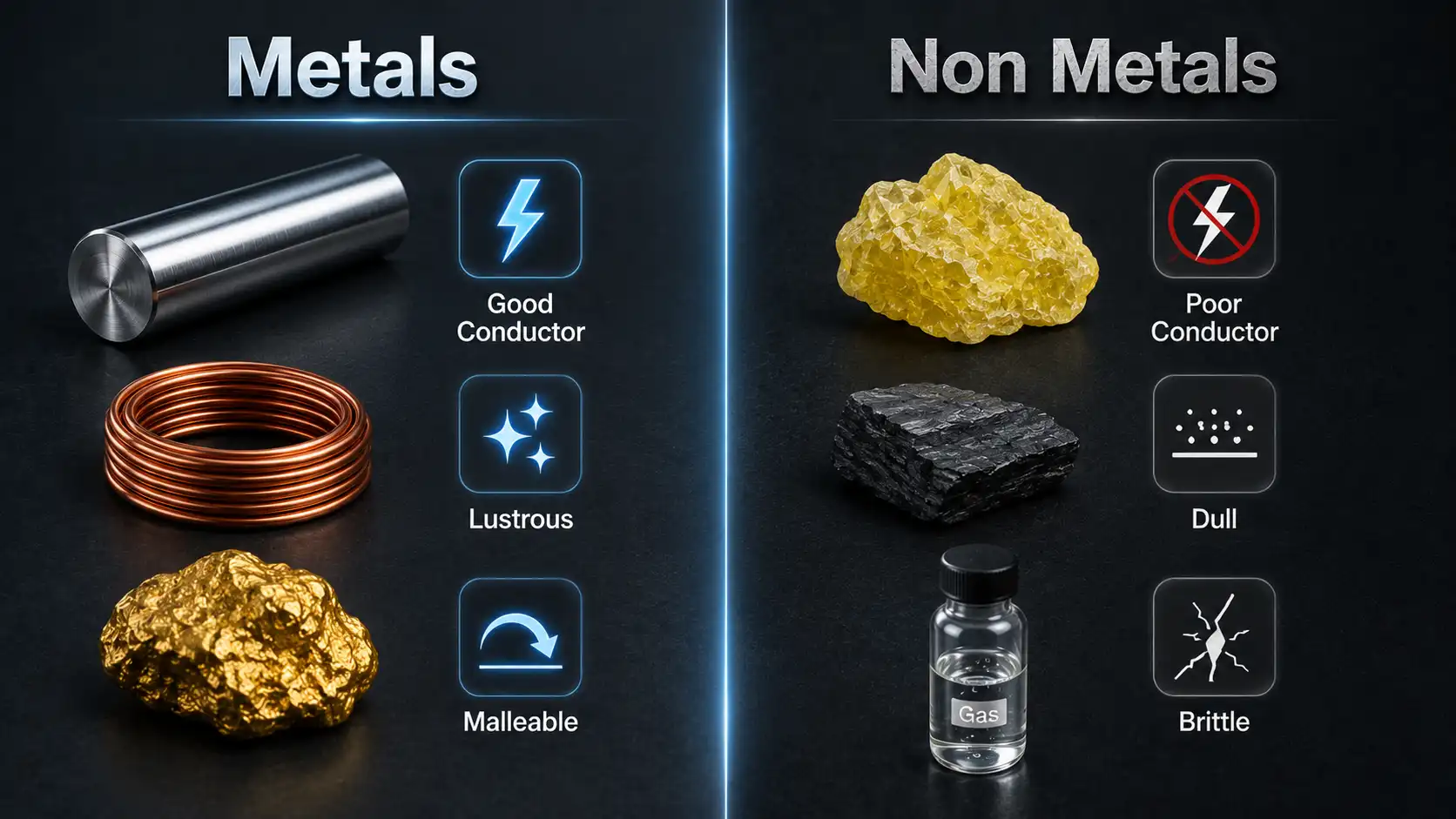
Understanding the metal versus non metal divide matters well beyond a chemistry classroom, because the two groups interact constantly in real applications. Non metals like carbon and oxygen combine with metals to form compounds such as iron oxide, better known as rust, or aluminum oxide, which actually forms a protective layer rather than a destructive one. This single distinction, whether an oxide layer protects a metal or slowly destroys it, directly affects how long a metal structure lasts, how much maintenance it requires, and whether it needs a protective coating at all.
Beyond the practical ferrous and non ferrous split used in industry, chemists classify metals according to their exact position on the periodic table, and this classification explains behavior at a much deeper, atomic level. Two metals might both be called transition metals, for example, yet behave completely differently in terms of reactivity, simply because of how many electrons sit in their outer shell. This section answers the types of metals in chemistry angle of the topic, which is distinct from the industrial classification covered later, though the two systems do overlap in places.
This periodic classification is genuinely useful because it predicts behavior before you even test the metal. An element from the alkali metal group will almost always react violently with water, regardless of which specific element it is, because that reactivity comes from a shared atomic structure across the entire group. This predictive power is why chemists rely on periodic groupings rather than just memorizing each element individually.
This periodic classification explains why some metals react violently with water while others barely respond to it at all, and it lays the scientific groundwork for the ferrous, non ferrous, and precious metal groupings covered next. Industry rarely refers to periodic groups directly when buying materials, but the underlying chemistry from this section explains why certain metals were selected for certain roles in the first place, whether that role is a structural beam, a coin, or a computer chip.
When people ask what are the main types of metals, the answer usually comes down to four practical categories: ferrous, non ferrous, precious, and alloys. Unlike the periodic classification above, this system groups metals by composition and real world behavior rather than atomic structure, which is exactly why it is the classification most used in construction, manufacturing, and everyday conversation about materials. Each category below includes a solid overview here, with a full dedicated guide linked for anyone who wants the complete breakdown of grades, compositions, and specific applications.
Choosing the right category for a project is often the very first decision a buyer or engineer makes, before even considering a specific metal name. Someone building an outdoor structure will typically start by ruling out plain ferrous metals because of rust risk, while someone designing a lightweight aircraft component will start by ruling out anything too dense. This section walks through all four categories in enough depth to make that first decision confidently.
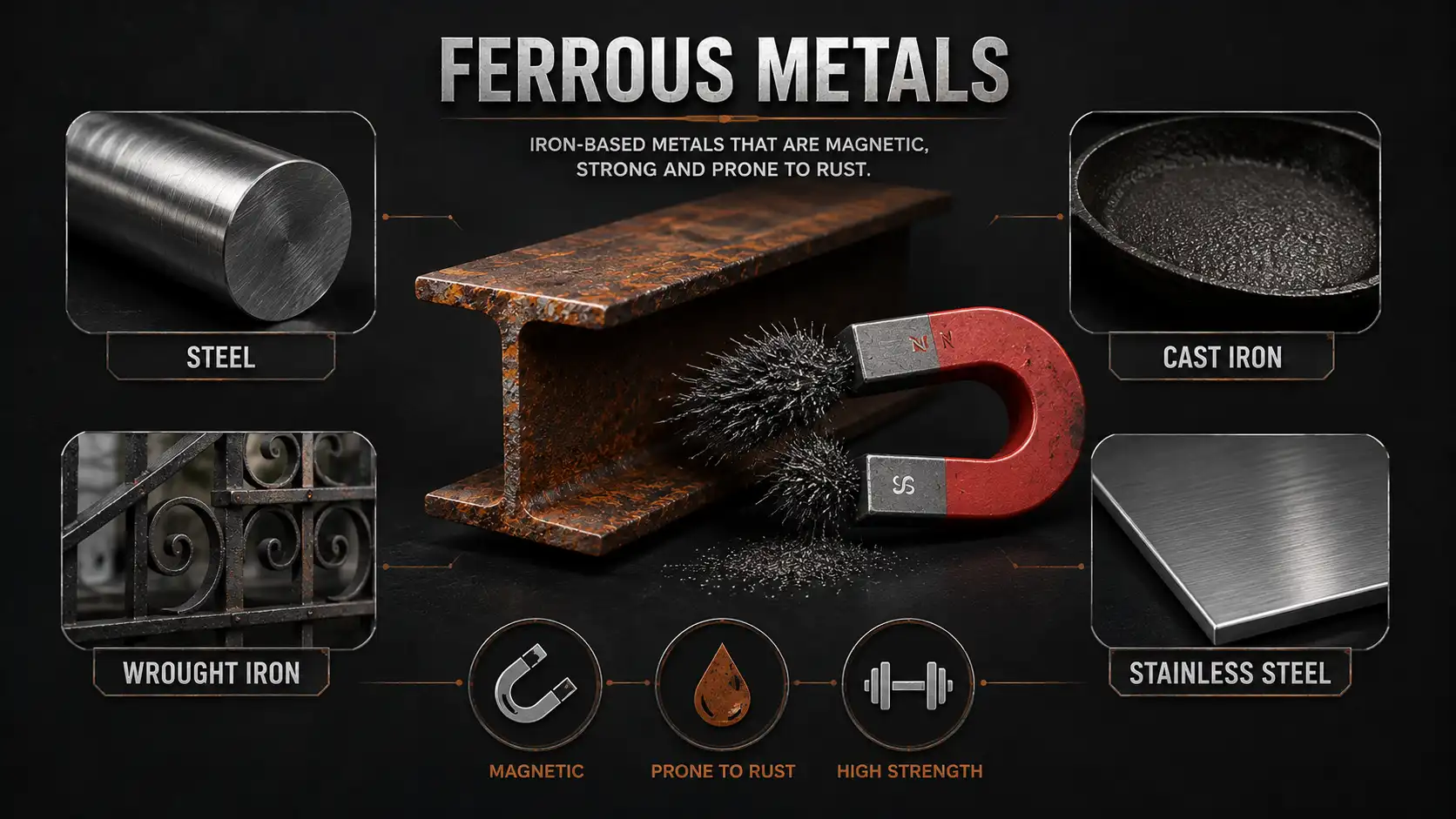
Ferrous metals contain iron as their main component, a name that comes directly from the Latin word ferrum, meaning iron. This single compositional fact drives almost every characteristic associated with this category. Because of that iron content, ferrous metals are usually magnetic, which makes them easy to identify with a simple magnet test even without lab equipment, and they are prone to rust when exposed to moisture and oxygen over time, since iron reacts readily with both. At the same time, ferrous metals are known for exceptional tensile strength and durability, which is exactly why they dominate construction, automotive manufacturing, and heavy machinery worldwide.
Common ferrous metals include:
Steel itself deserves a closer look because it is not one uniform material but an entire family, and the amount of carbon mixed into it decides almost everything about how a specific batch behaves. Mild, low carbon steel is cheap, easy to weld, and forgiving to work with, which is why it dominates construction beams and car body panels. Medium and high carbon steels trade some of that workability for significantly more hardness and strength, making them the standard choice for tools, chisels, and blades that need to hold an edge. High speed steel goes a step further by adding tungsten, molybdenum, and chromium, allowing cutting tools to stay sharp even while generating heat from friction. Stainless steel takes a different approach entirely, adding chromium specifically for corrosion resistance rather than raw hardness, which is why it shows up in cutlery, medical instruments, and food processing equipment.
This overview covers the basics. See the full Ferrous Metals guide for grades, composition percentages, and application specific comparisons in far more depth.
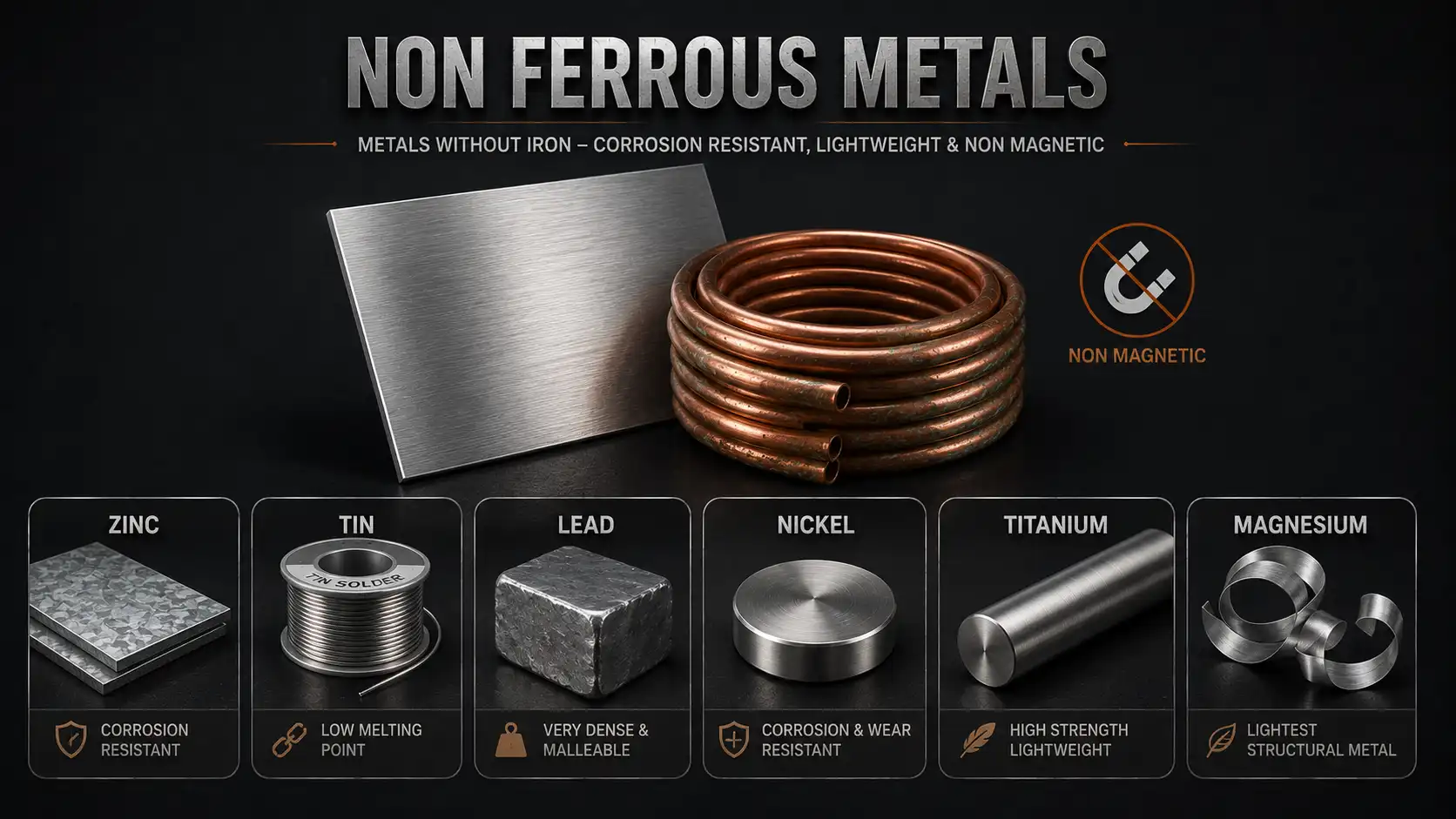
Non ferrous metals contain little to no iron, and this single fact makes them naturally resistant to rust and non magnetic in almost every case, which is often the deciding factor when a project needs to avoid corrosion or magnetic interference altogether. Compared to ferrous metals, non ferrous metals also tend to be considerably lighter in weight, a property that matters enormously in aerospace and transportation where every kilogram affects fuel efficiency. The tradeoff is that non ferrous metals are generally more expensive to extract and process than iron based options, since many of them occur in less concentrated ore deposits.
Common non ferrous metals include:
If a project specifically calls for a metal that will not rust and will not interfere with a magnetic field, such as medical scanning equipment or precision electronics, a non ferrous metal is almost always the correct answer. This category also tends to offer more variety in density and conductivity than ferrous metals do, giving engineers more room to fine tune a material choice around a very specific requirement, whether that requirement is minimizing weight, maximizing conductivity, or avoiding any magnetic response entirely.
This overview covers the basics. See the full Non Ferrous Metals guide for extraction, alloys, and industry specific uses in detail.
Precious metals are rare, naturally occurring metals valued for their scarcity, their resistance to corrosion, and their long standing role as a store of economic value across nearly every human civilization. Unlike most metals, they do not tarnish, rust, or react easily with air, water, or common acids, which is exactly why they have been used as currency, jewelry, and religious objects for thousands of years. This chemical stability is not a minor detail; it is the single characteristic that separates precious metals from every other non ferrous metal on this list.
The four metals almost universally classified as precious are:
What genuinely separates precious metals from other non ferrous options is not simply rarity, since some non ferrous metals are also relatively scarce, but rather their chemical stability over extremely long timeframes. A gold coin buried for a thousand years will still shine when unearthed with barely any surface change, while an iron tool from the same era would almost certainly be reduced to a crumbling mass of rust. This durability is precisely why precious metals became the natural choice for long term stores of value across ancient and modern economies alike.
Beyond investment portfolios and jewelry counters, precious metals also play a genuinely critical industrial role that often goes unnoticed. Silver and gold are used in small but essential quantities inside circuit boards, while platinum and palladium are essential components in reducing harmful vehicle emissions through catalytic converters. Buying or weighing gold or silver locally? The Tola, Gram, Oz & Kg weight converter makes it easy to convert between the units used in local and international markets.
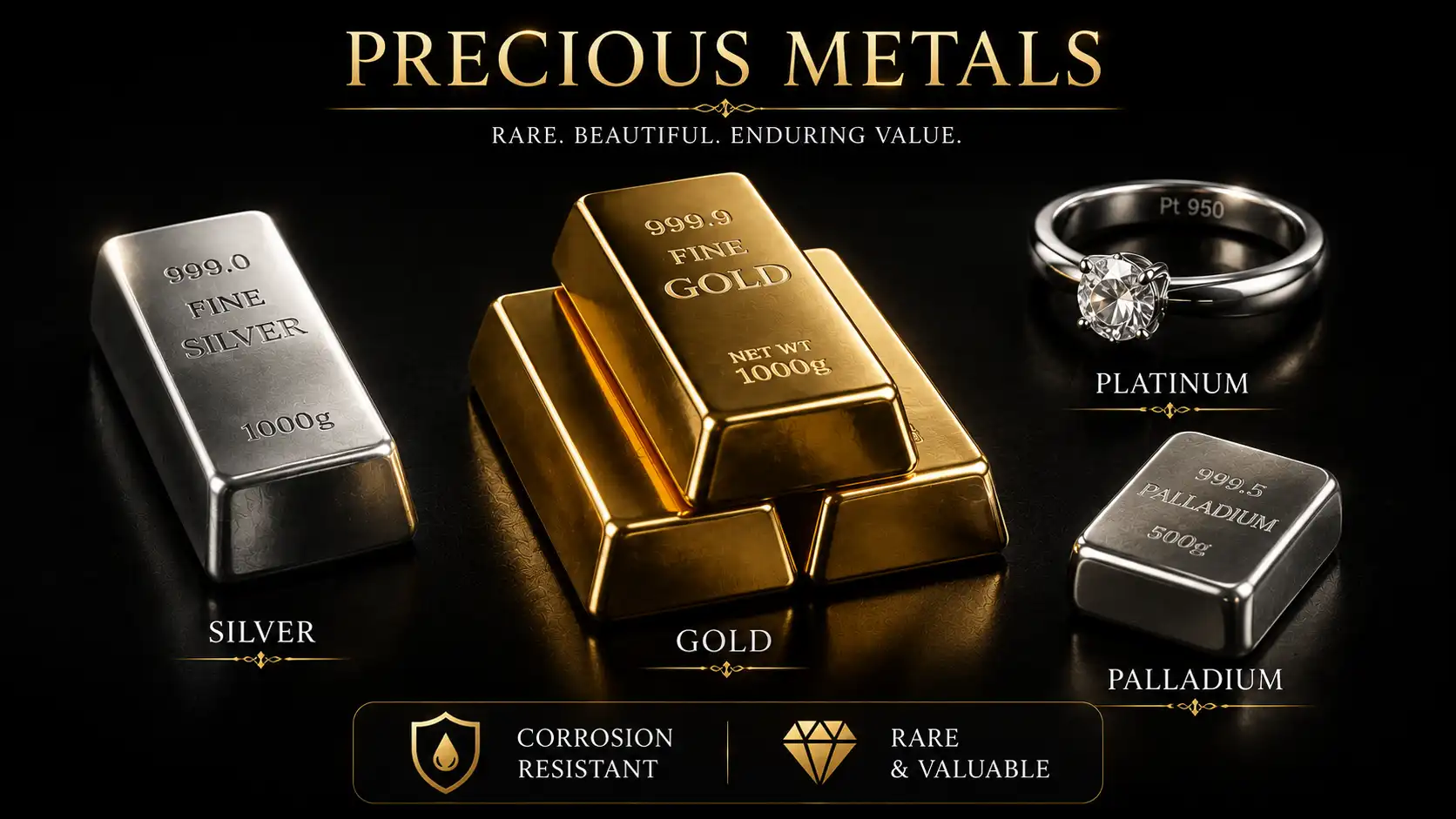
This overview covers the basics. See the full Precious Metals guide for grading, investment considerations, and jewelry specific comparisons.
An alloy is not a separate chemical element but a deliberately engineered mixture, made by combining two or more metals, or occasionally a metal with a non metal, to produce a material with better properties than either individual ingredient could offer alone. This single concept explains why pure iron is almost never used directly in construction, while steel, which is simply iron alloyed with carbon, holds up skyscrapers and bridges around the world. Alloying is one of the oldest forms of materials engineering, practiced long before the underlying chemistry was fully understood.
Alloying works because combining metals in the right ratio can boost strength, improve corrosion resistance, lower the melting point for easier casting, or improve overall workability, and the exact outcome depends heavily on which elements are mixed and in what proportion. A small change in ratio can produce a dramatically different material, which is why metallurgists spend significant effort fine tuning alloy compositions for specific applications rather than treating alloying as a rough or approximate process.
Some of the most common and widely recognized metal alloys include:
A simple visual trick helps distinguish two of the most commonly confused alloys: brass carries a yellowish gold tone, while bronze leans toward a reddish brown, and this color difference directly reflects their different base compositions of zinc versus tin. Beyond appearance, alloys ultimately prove a broader point that applies across all of materials science: the ideal material for a given job is often not a pure element at all, but a carefully engineered mixture designed with that exact application in mind.
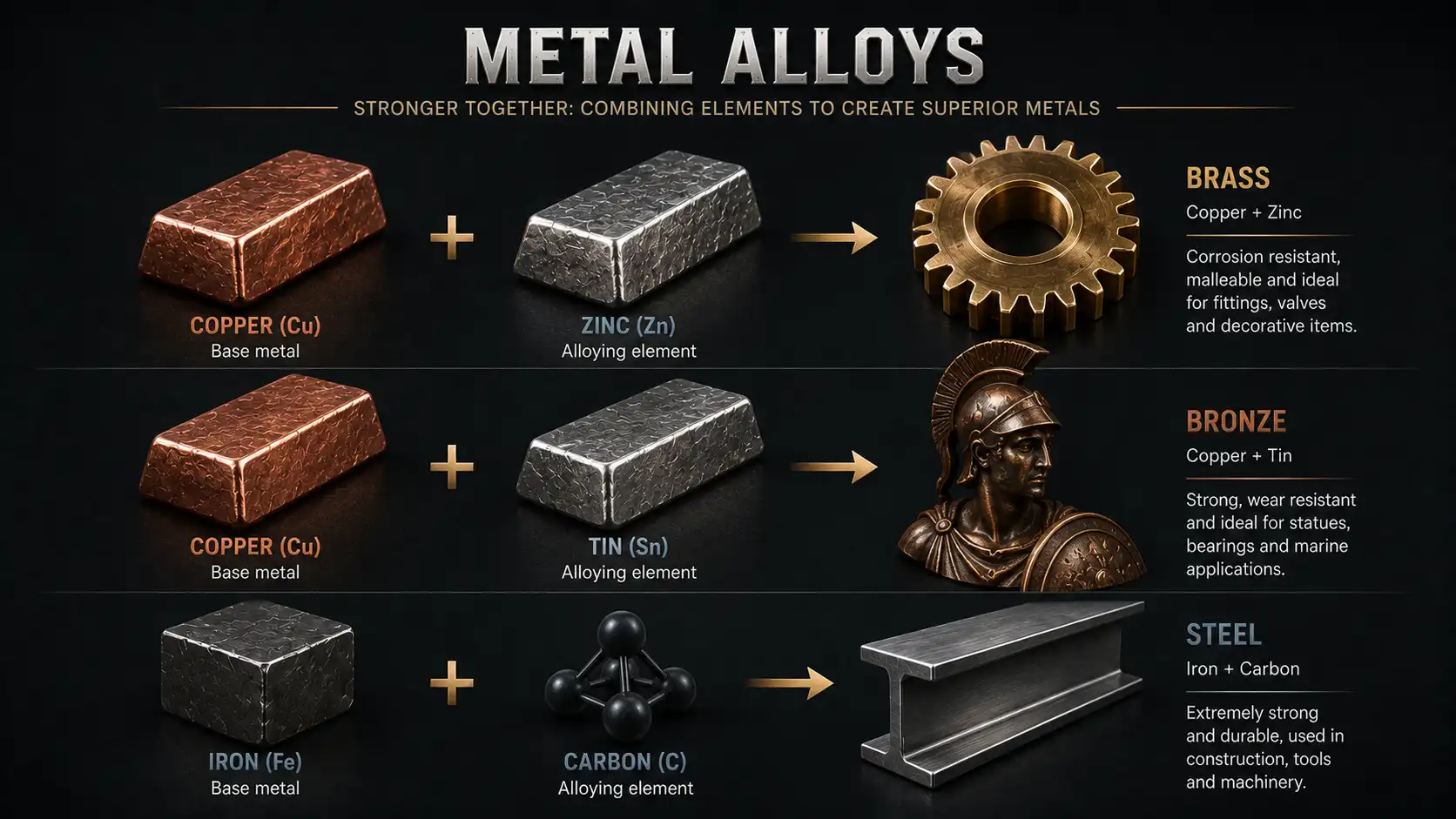
→ This overview covers the basics. A dedicated Metal Alloys guide would cover exact compositions, grades, and application comparisons in more depth.
For anyone who simply wants a fast, scannable reference rather than a full explanation, this section lists the most searched and most commonly used metals grouped by their practical category. Each metal listed here is either explained in detail above or will receive its own dedicated guide as this resource continues to expand, so this list also doubles as a preview of the wider topical cluster being built around this pillar article.
Ferrous metals: Iron, Steel, Stainless Steel, Cast Iron, Wrought Iron, Alloy Steel, High Speed Steel. These are the iron based metals covered in detail in the Ferrous Metals section above, and they form the backbone of the construction and heavy industry sectors.
Non ferrous metals: Aluminum, Copper, Zinc, Tin, Lead, Nickel, Titanium, Magnesium, Chromium, Cobalt. This group covers the lightweight, corrosion resistant, and non magnetic metals used heavily across electronics, transportation, and packaging.
Precious metals: Gold, Silver, Platinum, Palladium, Rhodium. These rare, corrosion resistant metals dominate jewelry, investment, and specialized industrial applications like catalytic converters.
Common alloys: Brass, Bronze, Sterling Silver, Duralumin, Pewter. These engineered combinations take the best traits of two or more base metals to solve a specific performance need.
Reactive and rare metals: Lithium, Sodium, Potassium, Uranium, Neodymium. This group spans highly reactive alkali metals used in batteries, all the way to radioactive elements used in energy production and rare earth metals used in powerful magnets.
This list covers the metals people search for by name most often, and it is intentionally organized to mirror the category structure used throughout the rest of this guide, so a reader can jump from a name here directly to the relevant section above for a full explanation.
Metal use is not a modern development; it fundamentally shaped entire eras of human civilization, and that deep history still explains why certain metals dominate certain industries today rather than others. Understanding this progression is not just historical trivia added for interest. It reveals a clear pattern: the metals humans adopted first were the ones easiest to find and shape with primitive tools, while metals requiring advanced extraction and processing arrived only once human technology had caught up with what those metals could offer.
This timeline also explains a lot about global infrastructure decisions made even today, since materials that were abundant and well understood early on, like iron and its alloys, became deeply embedded in engineering standards and manufacturing supply chains long before more advanced options like titanium became commercially viable. The chronological order below traces that progression from prehistory to the modern industrial era.
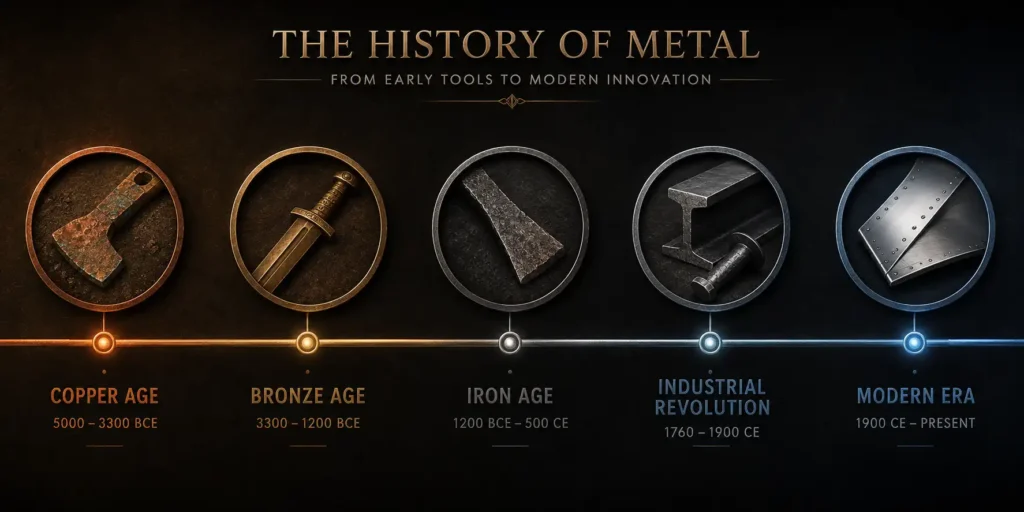
This progression directly explains the logic behind today’s practical classification system covered earlier in this guide. Metals that were easiest to extract and shape with early technology came first and became deeply woven into industrial tradition, while metals requiring more advanced processing, like refined steel and titanium, arrived only once human technology had genuinely caught up with what those metals could offer, and that same technological gap still influences cost and availability decisions today.
For anyone who wants a fast visual reference rather than reading through every section above, this chart brings together the most common metals covered in this guide, organized by category, key property, and the practical trade-off that comes with choosing each one. A chart like this is particularly useful when comparing options side by side for a specific project, since it condenses paragraphs of explanation into a single scannable format.
Metal | Category | Advantage | Limitation | Common Use |
Mild Steel | Ferrous | Cheap, easy to weld | Rusts easily outdoors | Construction beams |
Stainless Steel | Ferrous | Corrosion resistant | More expensive | Cutlery, medical tools |
Cast Iron | Ferrous | Strong under compression | Brittle | Cookware |
Aluminum | Non ferrous | Lightweight | Softer, lower strength | Packaging, aircraft |
Copper | Non ferrous | Excellent conductor | Relatively expensive | Electrical wiring |
Gold | Precious | Corrosion proof | Very expensive, soft | Jewelry, electronics |
Brass | Alloy | Low friction | Reacts with acids | Locks, instruments |
This chart directly addresses the types of metals with pictures and types of metals names intent that many readers are searching for, letting anyone scan a metal’s name, category, and trade-offs at a glance without needing to read every paragraph above it in full. One clear pattern worth noticing is that almost every ferrous metal listed here is magnetic, while every non ferrous and precious metal is not, which makes a simple magnet test genuinely one of the fastest and most reliable ways to identify what kind of metal you are holding without any lab equipment at all.
Every metal used in a real project is ultimately chosen based on its measurable properties rather than its appearance or price alone, and understanding these properties is what separates an informed material decision from a guess. These properties fall into two broad categories, physical and chemical, and both matter for different reasons depending on the application in question. A property that is critical for a bridge beam, like tensile strength, may be almost irrelevant for a piece of jewelry, where malleability and shine matter far more.
Physical properties describe how a metal behaves without any change to its underlying chemical makeup. Luster refers to the shiny, reflective quality most metals share, while density measures how heavy a metal is relative to its size, which is why tungsten feels remarkably heavy for its volume while aluminum feels light. Melting point varies enormously across metals, with tungsten holding the record among metals at over 3400 degrees Celsius, while metals like tin melt at a comparatively low 250 degrees Celsius. Malleability describes how easily a metal can be hammered into sheets, with gold recognized as the most malleable metal known, while ductility measures how well a metal stretches into wire, a property where copper and gold both excel. Conductivity, meanwhile, measures how efficiently a metal transmits electricity, and silver holds the top spot here, conducting electricity better than any other metal even though copper remains more common due to its lower cost.
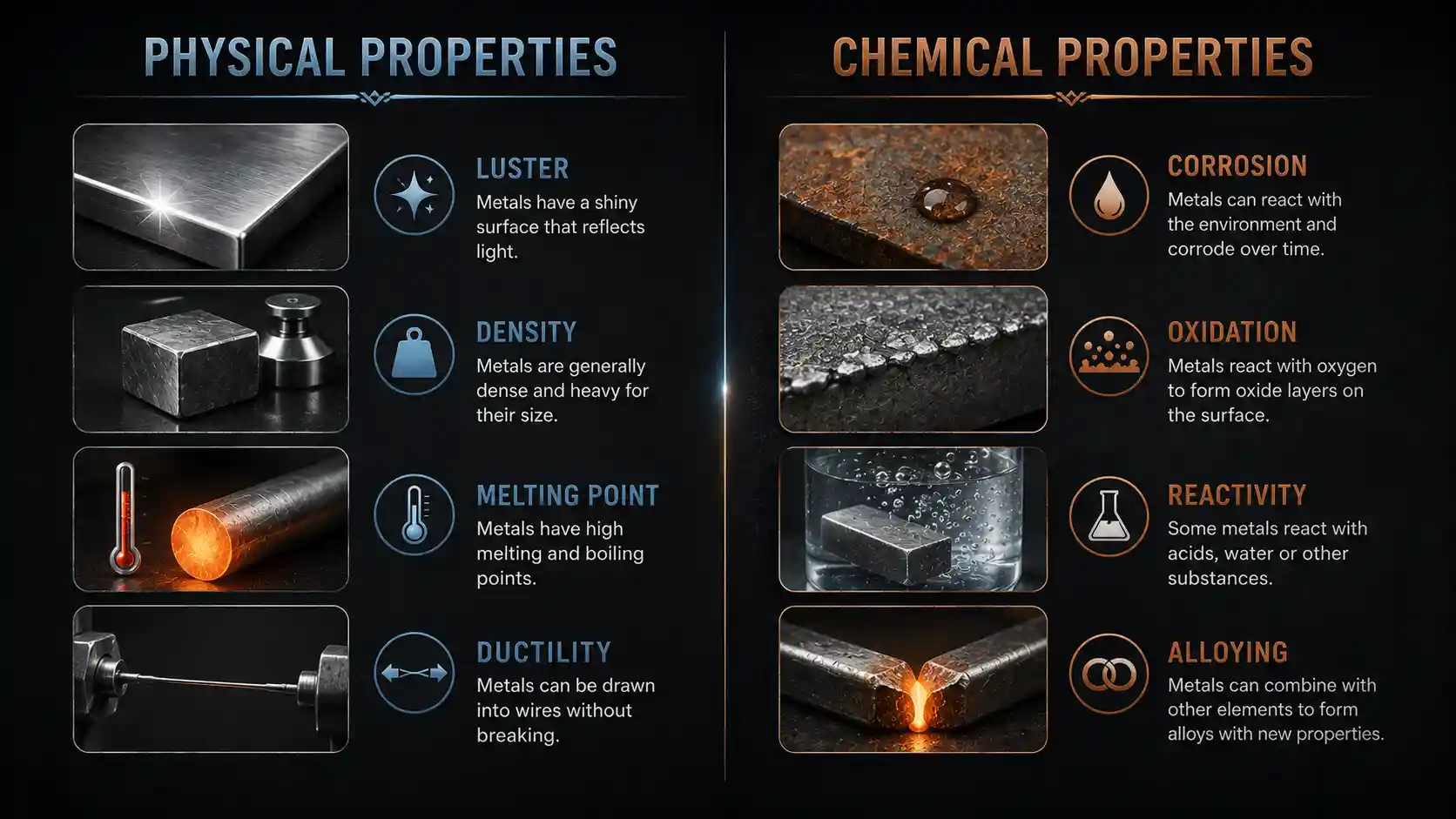
Chemical properties, by contrast, describe how a metal reacts with its surrounding environment over time, and these reactions genuinely determine how long a metal lasts in real world conditions. Corrosion resistance varies dramatically between metals, with gold and platinum barely reacting with air or water at all, while iron rusts comparatively quickly when exposed to the same conditions. Oxidation affects nearly every metal to some degree, forming a thin oxide layer on the surface that is sometimes protective, as with aluminum’s naturally forming oxide coating, and sometimes destructive, as with iron’s rust. Reactivity itself spans a huge range across the periodic table, with alkali metals reacting violently with water while noble metals like gold remain almost entirely inert under normal conditions. Alloying behavior, the final chemical property worth understanding, describes how easily a given metal bonds with other elements to form a useful alloy.
The practical takeaway from all of this is straightforward: a metal’s properties, not its price or its appearance, should ultimately drive material selection for any serious project. A contractor choosing between aluminum and steel is really choosing between weight and raw strength, since one clearly outperforms the other in each category. A jeweler choosing between silver and platinum is weighing electrical conductivity and brilliant shine against tarnish resistance and significantly higher cost. Every application, from a wedding ring to a load bearing bridge beam, ultimately comes down to matching these core physical and chemical properties to the actual demands of the job at hand.
Beyond raw composition, the specific way a metal is heated and then cooled can completely transform its hardness, strength, and flexibility, all without changing what the metal is actually made of at a chemical level. This is a genuinely important concept that many buying guides skip entirely, yet it explains why two objects made from the exact same grade of steel can behave in completely different ways depending on how each one was processed after casting.
Heat treatment works by rearranging the internal crystal structure of the metal through carefully controlled temperature changes, and different treatment methods produce very different structural outcomes even when starting from identical raw material. The five processes below cover the most common heat treatment methods used across the metal industry today.
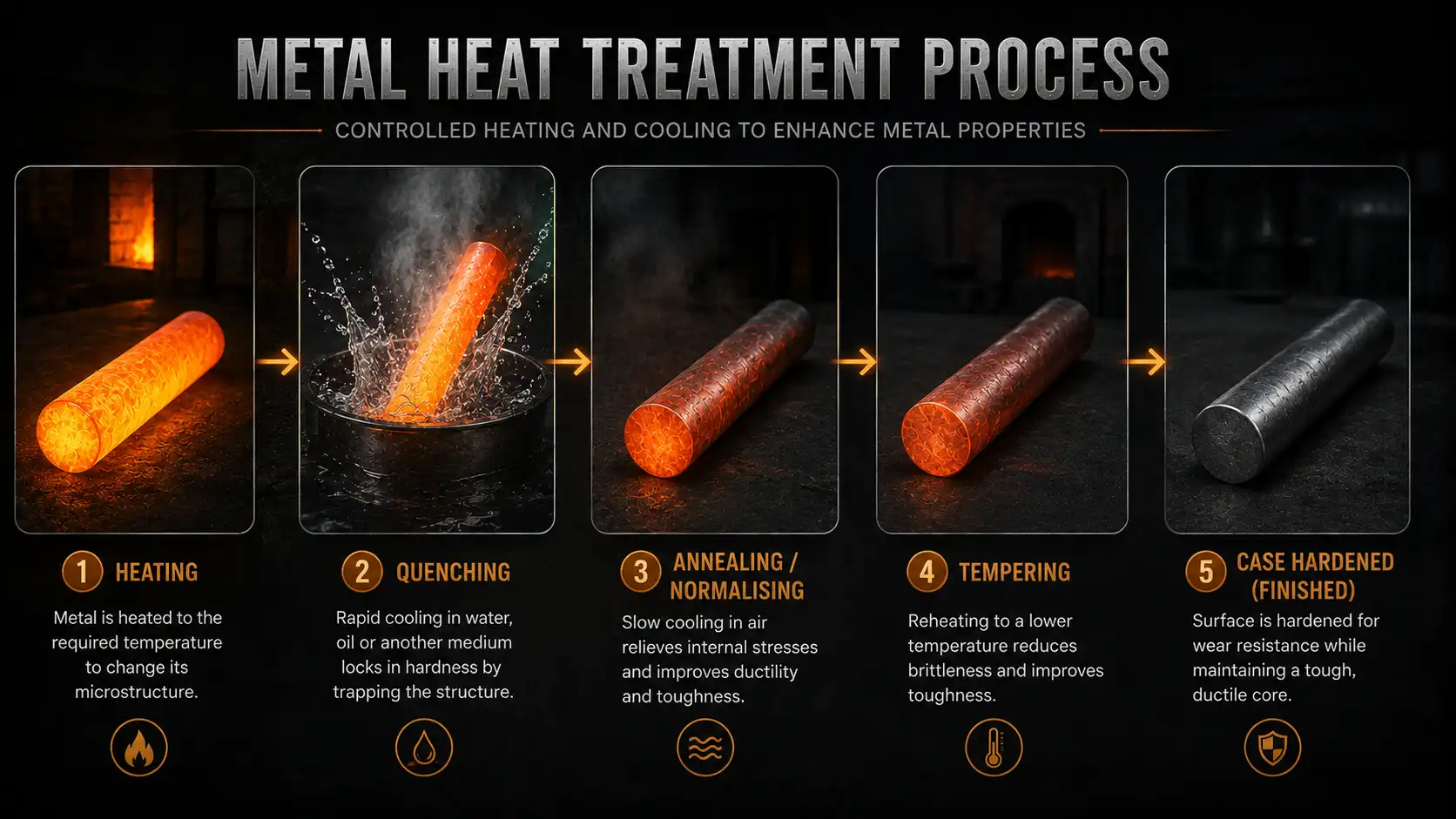
This is precisely why two objects made from the exact same steel grade can behave completely differently in the real world despite starting from identical raw material. A tempered spring and a hardened chisel might both begin as the same base steel, yet heat treatment is the actual deciding factor in how each one ultimately performs. Manufacturers select a specific heat treatment sequence based entirely on the end use of the finished part, not on the base metal alone.
Metals show up in nearly every part of daily life, often without much conscious thought given to why a specific metal was chosen for a specific job over an equally available alternative. Each major industry leans on a particular set of properties to make that selection, and understanding those industry specific priorities makes it much easier to predict which metal belongs in which application.
Construction and infrastructure relies heavily on ferrous metals, and steel in particular forms the structural skeleton of skyscrapers and bridges because of its exceptional tensile strength relative to its cost. Aluminum also plays a significant supporting role in this sector, showing up in window frames, roofing panels, and cladding for its light weight and natural corrosion resistance. Electronics and wiring, by contrast, depend almost exclusively on non ferrous metals, with copper remaining the industry standard for electrical wiring, while gold and silver appear in smaller quantities inside circuit boards and connectors, where long term reliability matters more than raw material cost.
Transportation is one of the few sectors that genuinely blends multiple metal types within a single product, and a modern vehicle is a good example of this layered approach. Steel typically forms the core chassis for its strength and affordability, aluminum reduces overall body weight to improve fuel efficiency, and titanium appears in select high performance parts where the strength to weight ratio justifies its considerably higher cost. Jewelry and accessories, on the other hand, center almost entirely around precious metals and their alloys, with gold and platinum dominating fine jewelry collections, while sterling silver offers a more affordable alternative without sacrificing much shine or wearability.
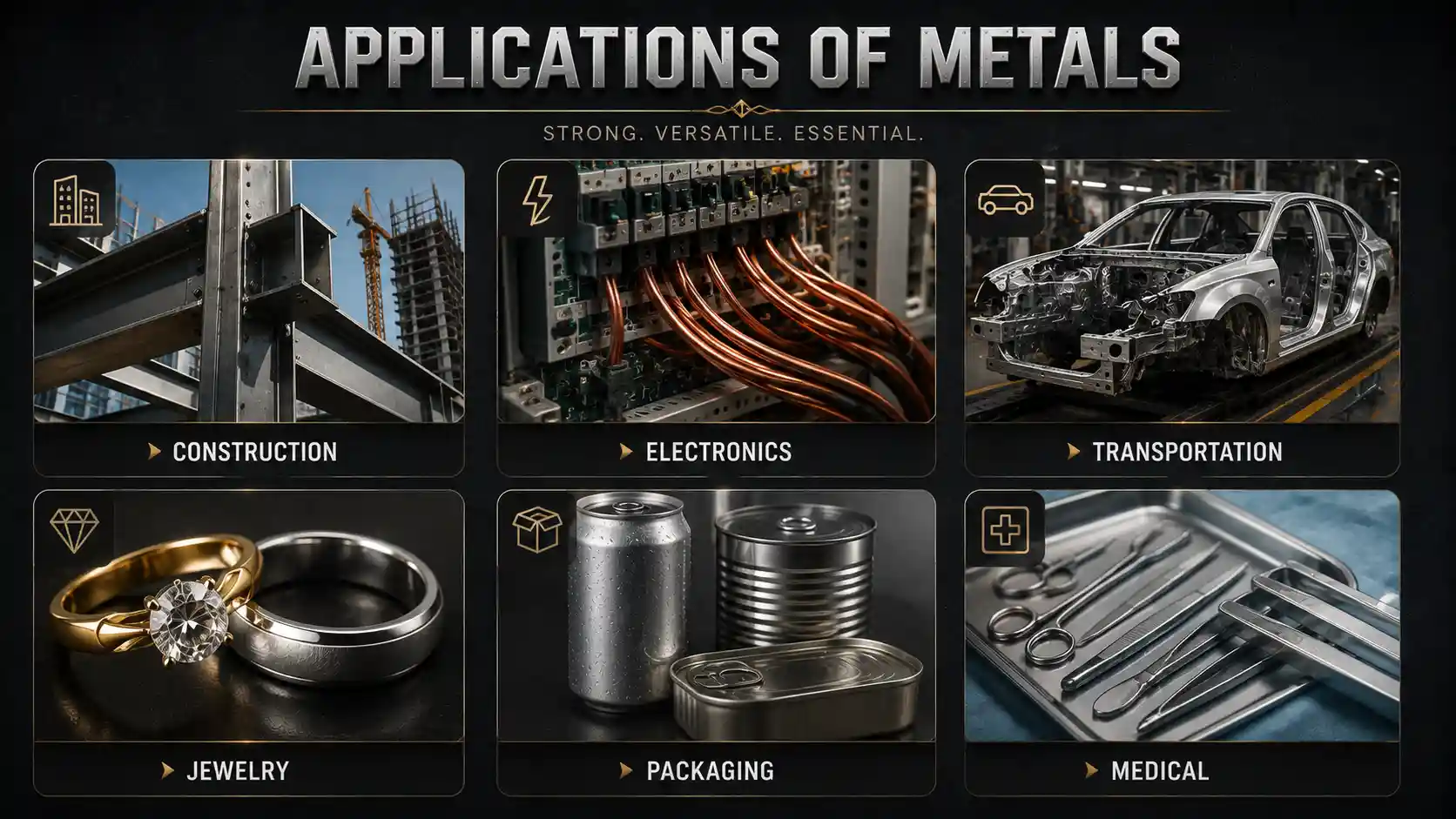
Packaging and food storage rely heavily on aluminum and tin specifically because both metals are non toxic and naturally corrosion resistant, a combination that makes them safe for direct contact with food and beverages over extended shelf life, from soda cans to canned food linings. Medical equipment, meanwhile, depends on stainless steel and titanium for surgical tools and implants, and both metals are chosen specifically because they resist corrosion inside the human body and will not trigger a harmful reaction when in prolonged contact with living tissue, a requirement that rules out most other metal options entirely.
Picking the right metal for a specific project comes down to carefully matching material properties to the actual demands of the job, rather than simply defaulting to whatever metal is cheapest or most familiar from past experience. This decision making process becomes far easier once it is broken down into a short list of practical factors, each of which can immediately rule certain metals in or out before cost even enters the conversation.
Strength versus weight is usually the first and most influential factor in construction and transportation projects, since these two properties often pull in opposite directions. Steel offers superior raw strength but adds considerable weight to a structure, while aluminum and titanium both trade away some strength in exchange for a much lighter build, which explains why aircraft manufacturers favor the latter two despite their higher cost per unit. Corrosion resistance becomes the dominant concern in outdoor, marine, or medical settings where moisture exposure is constant and unavoidable. Stainless steel, aluminum, and titanium all resist rust naturally without requiring an extra protective coating, while plain steel or iron will need ongoing protective treatment to survive the same conditions long term.
Conductivity requirements apply directly to any electrical or thermal application, and this is one of the more straightforward factors to evaluate since the performance difference between metals is well documented and consistent. Copper and silver lead this category by a clear margin, though copper wins out on cost in nearly every practical scenario, which is exactly why copper dominates household wiring while silver remains reserved for specialized high end electronics.
Budget and availability, meanwhile, often narrow the realistic choice set fast regardless of which properties would technically perform best on paper. Ferrous metals like steel and iron cost far less than most non ferrous options, and precious metals sit in an entirely separate cost category. Checking current scrap metal prices is a useful way to compare live market rates before finalizing a material budget for any larger project.
Magnetic requirements matter more than most people initially expect when planning a project, particularly in specialized fields like medical imaging or precision electronics. Equipment such as MRI machines and certain sensitive electronic components need non magnetic metals like aluminum or titanium, which immediately rules out most ferrous options regardless of how well they might perform on every other measure. A simple decision rule covers the majority of real world material choices: start by identifying the project’s single biggest constraint, whether that is weight, cost, corrosion resistance, or conductivity, and then narrow the metal choice down from that starting point.
Metals stand out from most other common materials because they can be recycled repeatedly without meaningfully losing quality or performance, unlike plastic, which degrades slightly with each recycling cycle and eventually becomes unusable for its original purpose. This near infinite recyclability is one of the strongest sustainability arguments in favor of metal as a material class, and it has become an increasingly important factor in how industries select materials for new products, not just how they dispose of old ones.
Steel, aluminum, and copper rank among the most recycled materials on the planet, with steel in particular recycled at rates that consistently outperform most other industrial materials by a wide margin. Recycling metal also uses dramatically less energy than extracting and refining brand new metal from raw ore, since the energy intensive mining, crushing, and smelting steps are largely skipped when working from scrap material instead. This energy savings translates directly into lower carbon emissions across the entire production chain, making recycled metal a genuinely more sustainable choice rather than just a marketing claim.
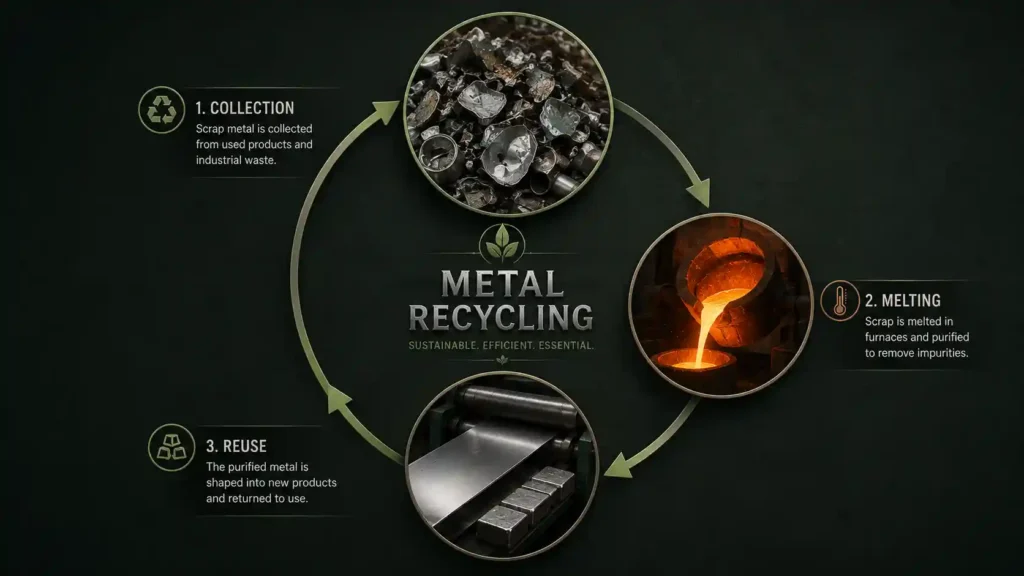
Metals do not biodegrade the way organic materials do, but they also do not simply vanish when discarded; instead they corrode or oxidize slowly over time, meaning a piece of scrap iron left outdoors will eventually rust into a weaker, flakier form rather than disappearing entirely. Mining and extraction of virgin metal ore can meaningfully damage local habitats through land disturbance, water usage, and chemical runoff, which is part of the reason recycled metal is increasingly prioritized across manufacturing supply chains wherever a viable scrap source exists. Some specific metals, such as lead, also carry direct health risks to humans and wildlife, and this has driven their steady phase out from consumer products even in cases where their physical performance properties remain genuinely useful.
For anyone weighing sustainability as part of a material decision, recyclability combined with lower processing energy makes steel, aluminum, and copper meaningfully stronger long term choices than metals that are either harder to reclaim from waste streams or that carry known toxicity concerns. Anyone selling scrap can check current scrap metal prices to see which recyclable metals currently offer the best return, since this environmentally responsible choice often lines up with the economically efficient one as well.
The three broad types are ferrous, non ferrous, and precious metals. Ferrous metals contain iron, non ferrous metals do not, and precious metals are rare, corrosion resistant metals like gold and silver. Alloys are sometimes counted as a fourth category.
Ferrous metals contain iron, making them magnetic and prone to rust. Non ferrous metals contain little to no iron, so they resist corrosion and are not magnetic. Steel is ferrous, aluminum is non ferrous.
When alloys are counted separately, the four main types are ferrous, non ferrous, precious, and alloy metals. Each is grouped by composition, iron content, rarity, and how the metals are combined or refined.
Most ferrous metals, including iron, steel, and cast iron, are magnetic. Nickel and cobalt are also naturally magnetic despite being non ferrous. Common non ferrous metals like aluminum, copper, and gold are not magnetic.
Steel and iron dominate construction for structural strength, while aluminum is common in frames and roofing for its light weight. Copper handles wiring, and stainless steel appears in fixtures needing corrosion resistance.
Brass is an alloy, made by combining copper and zinc. It is not a pure element, which is why its properties, like color and hardness, shift depending on the exact ratio of copper to zinc used.
Tungsten has the highest tensile strength of any natural metal, though steel alloys are often stronger in practical terms once other elements are added.
Gold, silver, platinum, and palladium are the four metals universally classified as precious. All four resist corrosion, are rare in nature, and hold long standing value.
Rust specifically refers to iron oxide, so non ferrous metals cannot rust since they lack iron. They can still corrode or tarnish over time, though most non ferrous metals resist this far better than ferrous metals do.
Understanding the different types of metals ultimately comes down to one core idea that ties this entire guide together: composition drives everything else, from strength and weight to corrosion resistance and long term cost. Ferrous metals bring exceptional strength and affordability at the expense of rust resistance, non ferrous metals offer lighter and naturally rust resistant alternatives at a higher price point, precious metals hold lasting economic and cultural value through their chemical stability, and alloys combine the best traits of multiple base metals into a single engineered material designed for a specific purpose.
Whether you are choosing a metal for a construction project, comparing jewelry options, or simply trying to identify what is sitting in your toolbox, the classification system covered throughout this guide, ferrous, non ferrous, precious, and alloy, gives you a reliable and repeatable framework to make that call with confidence. Beyond the four category classification, this guide also covered the periodic table’s atomic level grouping, the measurable physical and chemical properties that actually drive material selection, how heat treatment can reshape a metal’s performance without changing its composition, and the historical path that brought each of these metals into modern use.
Metal science continues to advance every year, with new alloys, protective coatings, and recycling technologies developed to solve corrosion, weight, and cost challenges across nearly every industry that relies on metal. Explore more metal guides, real time pricing, and recycling resources on MetalsWiki to go deeper into any specific metal covered in this guide.
See Current Scrap Metals Prices
Track real-time scrap metal prices across copper, steel, aluminum and brass — updated daily so you always know what your metal is worth

MetalsWiki.com offers accurate, up-to-date information on metals and real-time scrap metal prices for traders, recyclers, and professionals.