
Walk into any hardware store, construction site, or auto shop and you are surrounded by ferrous metals, even if you never notice them. Confused about which metals count as ferrous and why it even matters for your project? You are not alone, and getting it wrong can cost you time, money, or a part that rusts through in a year.
Ferrous metals are metals that contain iron as their main element, and that single fact explains almost everything about how they behave. They tend to be strong, magnetic, and prone to rust unless they are alloyed or coated to resist it. Steel, cast iron, wrought iron, and stainless steel all fall under this category, and together they form the backbone of buildings, vehicles, tools, and machinery around the world.
This guide breaks down every major type of metal within the ferrous family, their properties, how they compare to non ferrous metals, and where each one fits best, so you can choose the right material with confidence.
Ferrous metals are any metals that contain iron as a major part of their makeup. The word comes from the Latin term ferrum, which simply means iron, and that origin tells you almost everything about the category. If a metal has iron as its base or as one of its main ingredients, it is classified as ferrous.
This single trait, the presence of iron, is responsible for the traits people associate with these metals. Iron gives ferrous metals their characteristic strength and hardness, and it also makes most of them magnetic, since iron atoms respond strongly to magnetic fields. At the same time, iron reacts with oxygen and moisture, so most ferrous metals are prone to rust and corrosion unless they are treated, coated, or alloyed with elements like chromium to resist it.
Ferrous metals were not always in widespread use. Iron smelting only became common around 1200 BC, marking the start of what historians call the Iron Age, and it followed thousands of years after copper and bronze were already in use. Today, ferrous metals such as steel and cast iron are produced in far larger quantities than any other metal category, largely because iron ore is abundant and the resulting materials are strong, affordable, and highly recyclable.
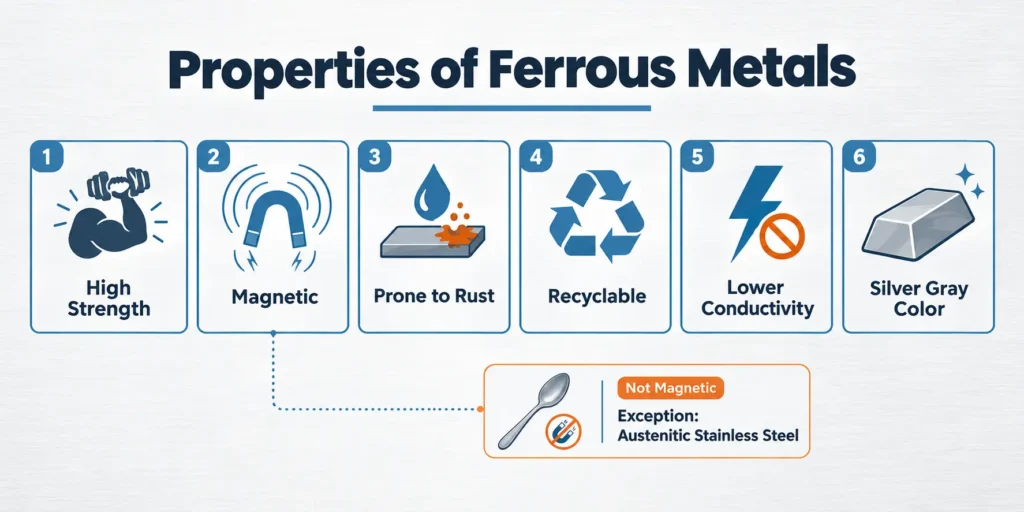
Ferrous metals share a set of traits that come directly from their iron content, though the exact behavior can vary depending on what else is alloyed in. Understanding these properties helps explain why certain ferrous metals get chosen for certain jobs.
The most commonly cited properties of ferrous metals include:
One property worth calling out on its own is magnetism, since it is not universal across every ferrous metal. Most ferrous metals are magnetic because of their iron content, but austenitic stainless steel is a well known exception. The high nickel content in austenitic grades shifts the crystal structure to a form called austenite, which is not magnetic even though the metal still contains iron. This is why a simple magnet test does not always give a reliable answer on its own when identifying ferrous versus non ferrous material.
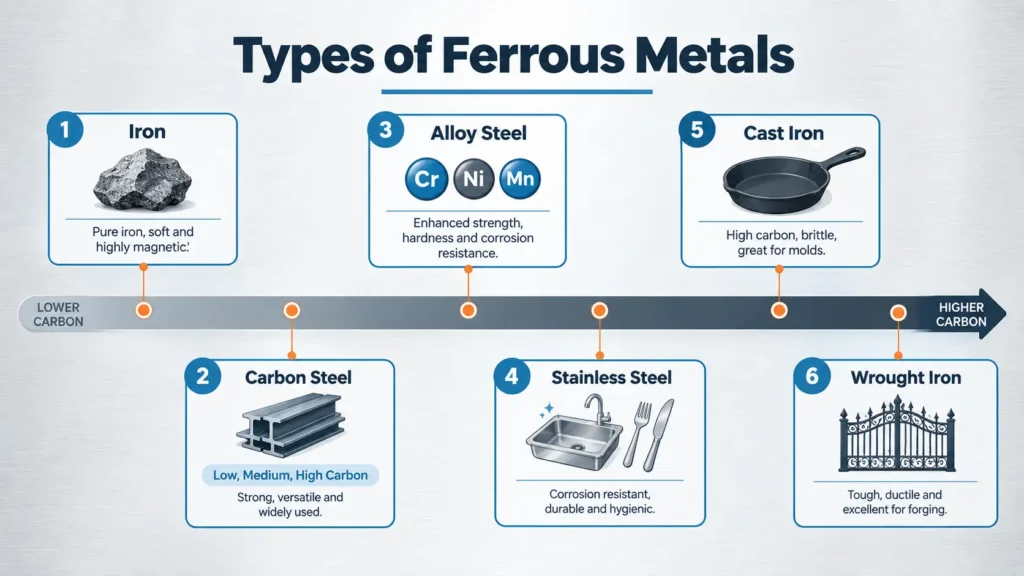
Ferrous metals are not a single material but a broad family, and each type has its own carbon content, alloying elements, and resulting properties. Understanding the differences helps you match the right ferrous metal to the right job, whether that is a load bearing beam, a decorative gate, or a piece of cookware.
The main types covered in this guide are iron, carbon steel, alloy steel, stainless steel, cast iron, and wrought iron. Each one starts from the same base element, iron, but small changes in composition create very different behavior in terms of strength, ductility, corrosion resistance, and cost.
Pure iron is the foundation of every ferrous metal, yet it is rarely used on its own in any meaningful industrial application. In its unalloyed form, iron is relatively soft and lacks the strength needed for most structural or mechanical uses. Instead, its real value comes from what it becomes once carbon and other elements are added to it.
Iron is extracted from iron ore through smelting, most commonly in a blast furnace, and the resulting pig iron is then refined further into steel or cast iron depending on how much carbon remains in the mix. Despite rarely appearing in its pure state on a job site, iron remains essential because every other ferrous metal in this guide traces back to it. Even small applications of pure iron still exist today, including certain wiring, magnetic cores, and specialty applications where its high purity is more valuable than added strength.
Carbon steel is the most widely used ferrous metal, and for good reason. It is an alloy of iron and carbon, with small amounts of other elements like manganese and silicon present but not significant enough to change its core behavior. The amount of carbon present, even a difference of a fraction of a percent, changes the steel’s strength, hardness, and workability dramatically, which is why carbon steel is split into three main categories.
Low carbon steel, often called mild steel, contains roughly 0.05 to 0.25 percent carbon. It is soft, ductile, and easy to weld or bend, which makes it the go to choice for car body panels, structural framing, nuts and bolts, and general fabrication work where flexibility matters more than raw hardness. Medium carbon steel sits between 0.25 and 0.6 percent carbon, giving it noticeably more strength and hardness than low carbon steel while sacrificing some ductility. This balance makes it common in automotive components such as gears, axles, and shafts, as well as railway applications where both strength and some degree of workability are needed.
High carbon steel contains between 0.6 and 1 percent carbon and is the strongest and hardest of the three categories, though this comes at the cost of reduced weldability and impact toughness. Because it holds its shape well under stress, high carbon steel is the material of choice for springs, cutting blades, wire rope, and wear resistant tools. Its main tradeoff is brittleness, since higher carbon content makes the metal more prone to cracking under sudden impact compared to its lower carbon counterparts.
Alloy steel takes carbon steel as its starting point and adds other elements in carefully controlled amounts to enhance specific properties. Unlike carbon steel, where iron and carbon are the main story, alloy steel is engineered so that each additional element brings a targeted benefit, whether that is corrosion resistance, higher strength, or better performance at extreme temperatures. This makes alloy steel a broad and highly versatile category rather than a single fixed material.
Chromium is one of the most important alloying elements, since levels above roughly 11 percent trigger the formation of a protective oxide layer that resists corrosion, a property that becomes the foundation of stainless steel. Nickel works alongside chromium to boost ductility and corrosion resistance further, and a combination of around 18 percent chromium with 8 percent nickel produces some of the most durable stainless steel grades used today. Manganese helps prevent the formation of harmful iron sulfides while improving strength at high temperatures and supporting better hardenability during quenching.
Silicon increases magnetic properties along with strength and elasticity, which is why it shows up in electrical steels used for transformers and motors. Vanadium limits grain size to improve ductility while also boosting hardness and shock resistance, though only in small quantities, since too much can weaken the alloy. Molybdenum improves performance at high temperatures and amplifies the effects of other alloying elements, making it valuable in steels meant for demanding industrial environments.
Stainless steel is best known for one defining trait, its resistance to corrosion, which sets it apart from nearly every other ferrous metal on this list. This resistance comes from chromium, and by definition, a steel needs at least 10.5 percent chromium content to be classified as stainless. That chromium reacts with oxygen in the air to form a thin, invisible passive layer on the surface of the metal, and this layer is what blocks moisture and oxygen from reaching the iron underneath, effectively stopping rust before it starts.
Not all stainless steel behaves the same way, since it splits into several distinct families depending on its internal crystal structure. Austenitic stainless steels, which contain higher nickel content, offer the best overall corrosion resistance and are also the exception to the rule that ferrous metals are magnetic, since their structure makes them largely non magnetic. Ferritic and martensitic stainless steels behave differently, with martensitic grades in particular offering more hardness and strength at the cost of some corrosion resistance. This range of options is why stainless steel shows up everywhere from kitchen cookware and surgical instruments to architectural facades and food processing equipment, since each grade can be matched to the exact balance of strength, appearance, and corrosion resistance a project needs.
Cast iron sits at the opposite end of the carbon spectrum from mild steel, and that difference defines almost everything about how it behaves. It contains a much higher carbon content than steel, typically somewhere between 2 and 4 percent, along with small amounts of silicon that help control how the metal solidifies. This higher carbon content gives cast iron excellent compressive strength and hardness, but it comes at a real cost, since the same property that makes it strong under pressure also makes it brittle and prone to cracking under sudden impact.
The way cast iron is manufactured plays directly into its most useful trait. Because it has a relatively low melting point and flows well while molten, cast iron is poured into molds while liquid, a process that allows it to take on complex shapes with minimal additional machining once it cools and hardens. This castability, combined with its low cost and good wear resistance, is why cast iron remains a practical choice for engine blocks, machine bases, pipes, and manhole covers, applications where the part sits under steady load rather than facing repeated sharp impacts. Cookware is another common use, since cast iron holds and distributes heat evenly, which is exactly the kind of steady, predictable stress it handles well.
Wrought iron sits almost at the opposite end of the ferrous metal spectrum from cast iron, since it contains only a very small amount of carbon, typically well under 0.1 percent, along with a small percentage of slag that gives it a fibrous internal structure. That low carbon content is the reason wrought iron behaves so differently from its higher carbon relatives. Instead of being hard and brittle, it is soft, ductile, and easy to bend, shape, or weld, which made it the material of choice for blacksmiths long before modern steel production took over.
That same fibrous grain structure, which becomes visible when the metal is etched or bent to failure, also gives wrought iron a natural resistance to rust that pure iron and higher carbon steels do not share. This is somewhat counterintuitive, since ferrous metals are generally prone to corrosion, but the slag content actually helps protect the metal from oxidation over time. Modern construction rarely uses true wrought iron anymore, since mild steel is cheaper and more available, but wrought iron still holds a strong place in ornamental ironwork such as gates, fences, and railings, where its workability and classic appearance matter more than raw industrial output.
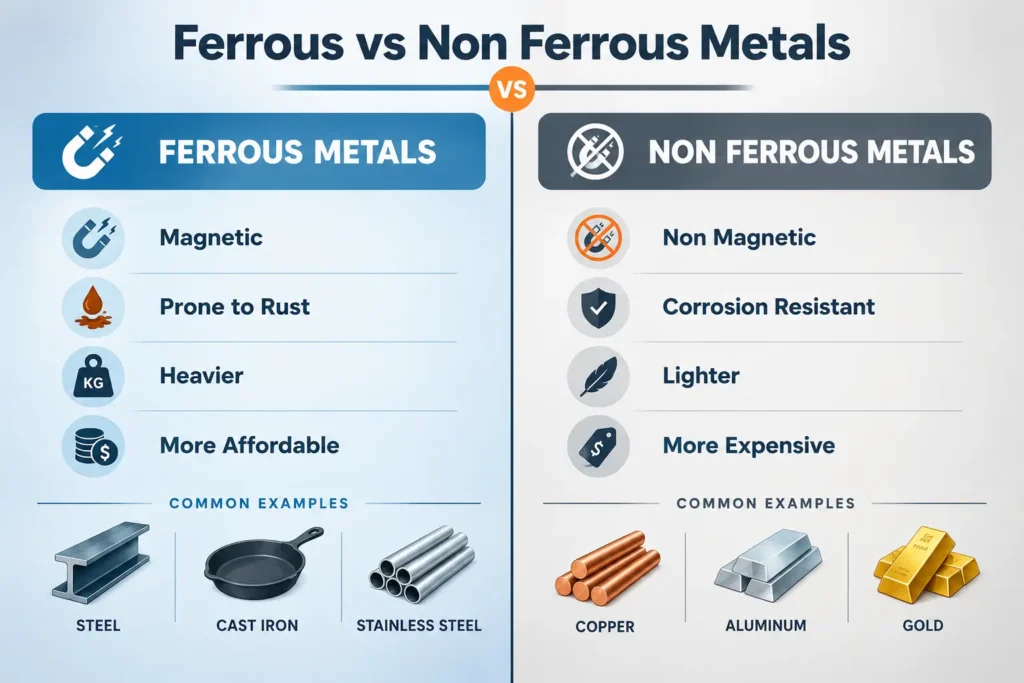
The line between ferrous and non ferrous metals comes down to one simple factor, whether iron is present in meaningful amounts. Ferrous metals contain iron as a major component, while non ferrous metals do not, and that single difference cascades into nearly every other property that separates the two categories, from magnetism to corrosion resistance to weight.
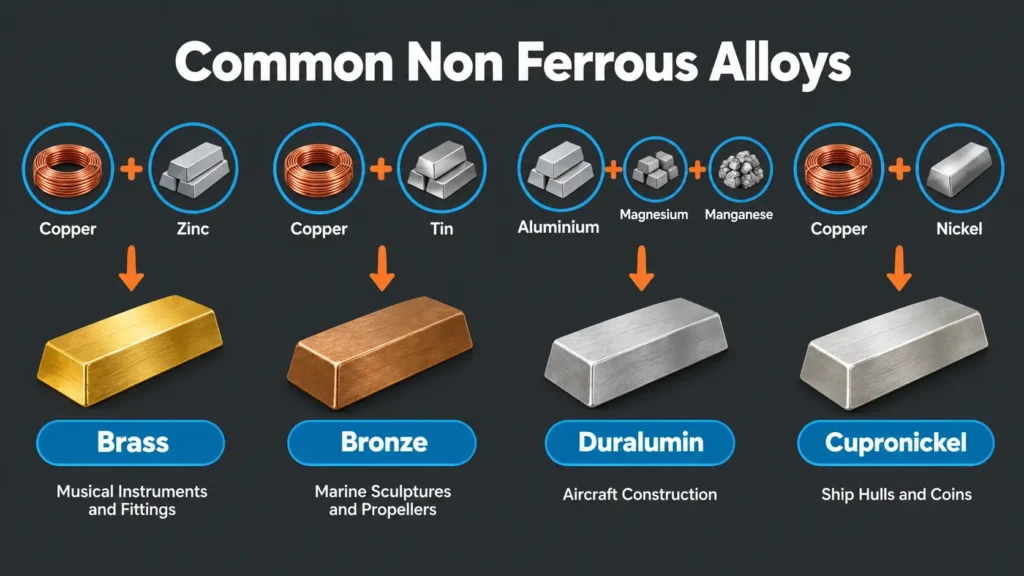
Non ferrous metals actually came into use long before ferrous metals did. Copper was worked as early as 5000 BC, marking the start of the Copper Age, and later gave rise to bronze once tin was added to the mix. Iron production did not become widespread until around 1200 BC, so in historical terms, non ferrous metals have roughly a 4000 year head start. Common non ferrous metals include copper, aluminum, lead, zinc, tin, and precious metals like gold and silver, and none of them contain iron as a primary element.
Here is a direct comparison of how the two categories stack up:
Property | Ferrous Metals | Non Ferrous Metals |
Iron content | Contains iron as a major component | Contains little to no iron |
Magnetism | Usually magnetic, with exceptions like austenitic stainless steel | Generally non magnetic |
Corrosion resistance | Prone to rust unless treated or alloyed | Generally more corrosion resistant |
Weight | Typically heavier and denser | Often lighter, especially aluminum and titanium |
Cost | Generally more affordable due to abundant iron ore | Often more expensive due to extraction complexity |
Common examples | Steel, cast iron, wrought iron, stainless steel | |
Typical uses | Construction, structural framing, heavy machinery | Electrical wiring, roofing, plumbing, jewelry |
A question that comes up often is whether gold counts as a ferrous metal, and the answer is no. Gold contains no iron at all, which places it firmly in the non ferrous category along with other precious metals like silver and platinum. This distinction matters in practice too, since choosing between a ferrous and a non ferrous metal usually comes down to whether a project needs the strength and affordability of iron based materials or the corrosion resistance, conductivity, and lighter weight that non ferrous metals typically offer.
Ferrous metals show up across nearly every major industry, and the specific type used almost always traces back to the balance of strength, cost, and workability that industry needs most. Their combination of high tensile strength, wide availability, and relatively low cost makes them the default choice wherever heavy loads or long term durability matter more than light weight or corrosion resistance.
Construction relies on ferrous metals more than almost any other sector, since steel and cast iron form the structural backbone of buildings, bridges, and infrastructure projects. Structural steel beams, columns, and rebar reinforcement inside concrete all depend on the high tensile strength that ferrous metals provide, allowing structures to bear enormous loads without failing under stress.
Transportation and automotive industries use ferrous metals extensively, from car frames and engine blocks to railway tracks and shipbuilding hulls. Steel in particular is valued here for its combination of strength and impact resistance, both of which matter when a vehicle needs to protect its occupants during a collision or a rail line needs to hold up under constant weight.
Consumer goods made from ferrous metals include kitchen appliances, cookware, tools, and furniture hardware, where affordability and long service life make them a practical everyday choice.
Medical equipment, including surgical instruments, hospital beds, and diagnostic tools, often relies on stainless steel specifically, since its corrosion resistance and ability to withstand repeated sterilization make it safe for clinical environments.
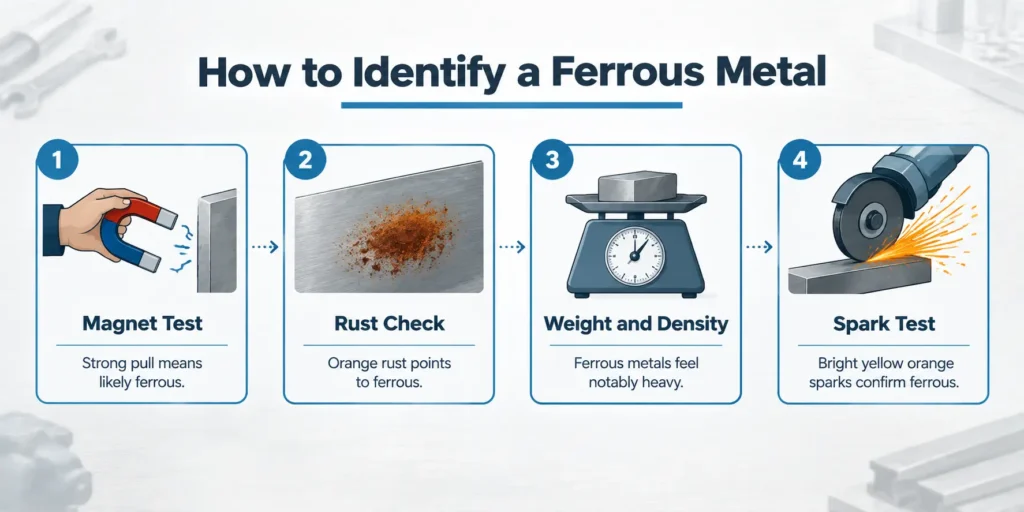
Sometimes you need to know whether a piece of metal is ferrous without access to a lab or a spec sheet, and fortunately there are a few practical checks that work well in most everyday situations. None of these tests is perfect on its own, but combining two or three of them gives a reliable answer for the vast majority of cases.
The simplest and most common test is the magnet test, since most ferrous metals are magnetic due to their iron content. Hold a magnet against the surface, and if it grips strongly, the metal is very likely ferrous. This test does have a known exception worth remembering, since austenitic stainless steel contains iron but is largely non magnetic because of its crystal structure, so a weak or absent magnetic pull does not automatically rule out a ferrous metal.
A few other checks can help confirm what the magnet test suggests:
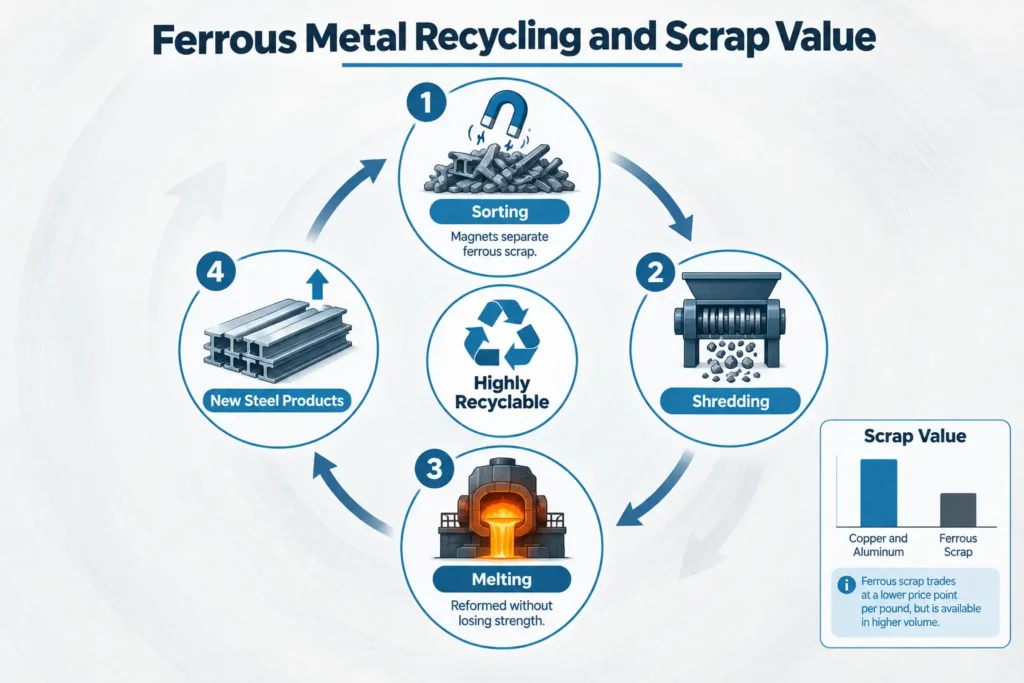
Ferrous metals rank among the most recycled materials on the planet, and that fact alone makes recycling one of the most practical advantages of choosing them for a project. Steel and iron can be melted down and reformed repeatedly without any meaningful loss in strength or quality, which is very different from some materials that degrade with each recycling cycle. This durability under repeated processing is part of why scrap yards actively seek out ferrous scrap rather than treating it as waste.
The recycling process itself starts with sorting, where ferrous scrap is separated from non ferrous material, often using large magnets on an industrial scale since the same magnetic property that helps identify ferrous metal by hand also makes automated sorting fast and effective. Once separated, the scrap is shredded, melted in a furnace, and reformed into new steel products, a cycle that uses significantly less energy than producing steel from raw iron ore. This is one reason the construction and automotive industries rely so heavily on recycled steel content today.
Scrap value for ferrous metals tends to run lower per pound than non ferrous scrap like copper or aluminum, simply because iron ore is abundant and ferrous metals are cheaper to produce in the first place. That said, the sheer volume of ferrous scrap generated by construction demolition, old vehicles, and industrial equipment means scrap yards still handle far more ferrous material by weight than any other category, making it a steady and dependable part of the recycling economy even at a lower price point per unit. You can track current scrap metal prices to see how ferrous and non ferrous scrap values compare in real time.
Every material choice comes with tradeoffs, and ferrous metals are no exception. Weighing these pros and cons side by side makes it easier to decide whether a ferrous metal is the right fit for a given project or whether a non ferrous alternative might serve better.
Ferrous metals include iron, carbon steel, alloy steel, stainless steel, cast iron, and wrought iron. What ties them together is iron content, since each of these metals uses iron as its primary or major component, giving them shared traits like strength and magnetism.
No, aluminum is a non ferrous metal since it contains no iron. This is why aluminum is lightweight, resistant to rust, and non magnetic, all traits that set it apart from ferrous metals like steel and cast iron.
Common non ferrous metals include copper, aluminum, zinc, lead, and tin. Precious metals like gold and silver also fall into this category, since none of them contain iron as a primary element.
Ferrous metals contain iron, making them magnetic and prone to rust. Non ferrous metals lack iron, making them generally non magnetic and more corrosion resistant, though often more expensive and lighter in weight.
Common ferrous metals include carbon steel, alloy steel, stainless steel, cast iron, and wrought iron. Each type varies in carbon content and alloying elements, which changes its strength, hardness, and resistance to corrosion.
Ferrous metals are typically strong, durable, and magnetic, though prone to rust unless treated or alloyed. They are also highly recyclable and generally more affordable than non ferrous metals, though heavier and less conductive.
No, gold is not a ferrous metal since it contains no iron. Gold belongs to the non ferrous and precious metal categories, valued for its resistance to corrosion and tarnishing rather than structural strength.
Most ferrous metals are magnetic, but not all. Austenitic stainless steel is a notable exception, since its high nickel content shifts its internal structure to a form that is largely non magnetic despite containing iron.
Yes, ferrous metals are among the most recycled materials in the world. Steel and iron can be melted down and reformed repeatedly without significant loss of strength, making ferrous scrap valuable to recyclers and scrap yards alike.
Ferrous metals remain one of the most practical material choices available today, and understanding their types, properties, and uses makes it far easier to pick the right one for any project. From the affordability and workability of mild steel to the corrosion resistance of stainless steel and the compressive strength of cast iron, each ferrous metal fills a specific role that non ferrous alternatives simply cannot match at the same cost.
As industries continue pushing toward more sustainable material choices, the recyclability of ferrous metals is likely to matter even more heading into 2026 and beyond, especially as scrap steel plays a growing role in reducing the energy footprint of new construction and manufacturing. Whether you are choosing material for a build, a repair, or simply trying to understand what surrounds you every day, ferrous metals will continue shaping the world in ways both visible and easy to overlook.

MetalsWiki.com offers accurate, up-to-date information on metals and real-time scrap metal prices for traders, recyclers, and professionals.